
7 Digital Marketing Strategies to Attract Chinese Tourists

Buckle up! 2023 is going to be an amazing year for the global tourism industry. Borders with China finally reopened, Chinese are craving to travel again. Even though, all air connections havent’ been resumed yet, air traffic and connections with China should be back to pre-covid levels before mid of this year. So, be ready and implement now a winnning strategy to attract exicted Chinese tourists to your destination.
Here you will give you the main keys to help you to attract the Chinese tourists.
Cost-Effective Agency
KPI and Results focused. We are the most visible Marketing Agency for China. Not because of huge spending but because of our SMART Strategies. Let us help you with: E-Commerce, Search Engine Optimization, Advertising, Weibo, WeChat, WeChat Store & PR.
An appealing website (in Chinese) with a nice feel-and-touch
The first thing you have to do to have some presence online is using the old way which is creating a website. However, having a website doesn’t ensure that you will attract Chinese visitors. You have to tailor your website to the needs of the Chinese market. There are several ways to go around it.
#1 Have a clear website with Good content in Chinese!
The first and most important thing to do is to have a website available in Chinese. If your main objective is to reach Chinese customers, an English website won’t be efficient, so make sure that you included Translation fees into your budget. You can also find a bilingual team member, or even better, Webmaster who could assist you during the whole process of creation. In fact, China is ranked 62th (111 countries tested) in the English Proficiency Index developed by EF (Education First) and is declared to be a low-proficiency country. Thus, the necessity of using 简本中文 (simplified Chinese) when writing your website.
#2 It’s not only about the looks, but it’s also about what is inside
- Have high-quality content
You created your website, in Chinese, but what about the content? In order to attract visitors, you will have to have just like for any other website, relevant content. This content may be various such as pictures, general information about countries, offers, coupons, social media links, and so on.
- Have high-quality pictures
Writing great articles or texts will help to show your expertise in your tourism sector and attract visitors from search engines. However, if that’s all you have, it may create a non-harmonious website (great texts but low-quality pictures). You have several options to find these professionally taken pictures: in-house taken pictures by local travel agents with a DSLR camera, buy pictures online, use loyalty free pictures (make sure they can be commercially-used).

#3 Have an SEO strategy
Now that you have a very nice website in Chinese with high-quality pictures and relevant content, it’s time to bring Chinese visitors aboard. Before going on a trip, Chinese travelers always search for information on the internet. Where do they search? They usually go on Baidu first. The Chinese search engine is the most commonly used in China (Baidu owns more than 80% of market share).
So to set up a SEO campaign you will need to adapt your strategy to the requirement of the Chinese search engine. You shouldn’t think that a simple copy-paste of your Google SEO strategy is enough. It is not. Hereinbelow are some tips to know in order to get the most out of your Baidu SEO strategy :
- Host your website in China
- Establish a physical entity in China in order to create a real contact with potential website’s visitor
- Use Baidu’s tool: Baidu keyword planner, Baidu Feng Yun Bang (similar to Google Trend), or Baidu Index
- Update your content frequently: it will influence your ranking on the search result pages
- More secret tips on our previous article: Top 20 Baidu SEO Secrets
#4 Use e-travel platforms
Having your own website is a great way to publish your own content, contact information and specific details about your company, but if your main aim is to reach Chinese tourists and attract them to purchase. Hence, a “double online presence” will surely serve you well. You can register your business (hotel, restaurant, etc.) on these famous Chinese platforms.
#5 Social media

Chinese people are very keen on using social media. As early of 2022, China counted not less than 1.02 billion internet users, 983 million of them being social media users. It should also be noted that 99.6%f of the Chinese netizens use their mobile phone to go online.
AirBnB on Weibo
If you want to strengthen you daily visitor count, convert them into customers, you should be aware of the impact of social media on Chinese tourists and be present on WeiBo, related blogs (guest blogging, partnership, …) and forums such as Douban, Qyer and LVmama.

OnlyLyon: tourism organization of Lyon(France)
They use attractive contest online to catch Chinese opinion like this photo contest.

#6 Zoom on WeChat

Among all social media platforms in China, the most famously used daily by Chinese tourists is WeChat called Wei Xin (微信) in Chinese. WeChat is a text and voice messaging mobile app founded by Tencent (a Chinese company) with more than 900 million active users all around the world and 1.3 billion monthly active users. The main market is China with 2/3 of its users located in China.
Including WeChat in your digital strategy to attract Chinese tourists is one powerful tool. In order to bring a strong follower base as well as potential customers back on your website or account on other Chinese travel websites, you have to engage them as much as you can. To help in this process and to enjoy even more features, you may create a company official account.
One of the various features of WeChat is the possibility to create your own app (official service account). This is what Shanghri-La hotels did. Their app enables the WeChat user to compare prices.

Source: WalkTheChat
#7 KOL – Key Opinion Leaders
Last and not least, word-of-mouth is very strong in China. Mainly because of the fact that in Chinese culture, the relationships we have with others are very important. There are two main Chinese principles: Guan Xi (关系 – extended social network, long term relationships) and Mian Zi (面子 – Others perception of us).
Because of these and other factors, Chinese tourists strongly value others opinions and recommendations. That is why relying on Chinese influencers, called KOL (Key Opinion Leaders), is a very effective strategy to attract more Chinese tourists to your business. A KOL is someone online with a high following rate. It can be an actor, a TV show host, a singer, online celebrity or a model.

Many organizations working in the Tourism industry looking to attract Chinese customers created partnerships with KOLs. One of these organizations was the Switzerland Tourism Office located in Beijing invited Wangshi, a Chinese alpinist and blogger (Sina and Sohu) with more than 23 million readers at that time as well as founder of Wanke Real Estate to come to Switzerland.

Our Case Study
MyNextMemory

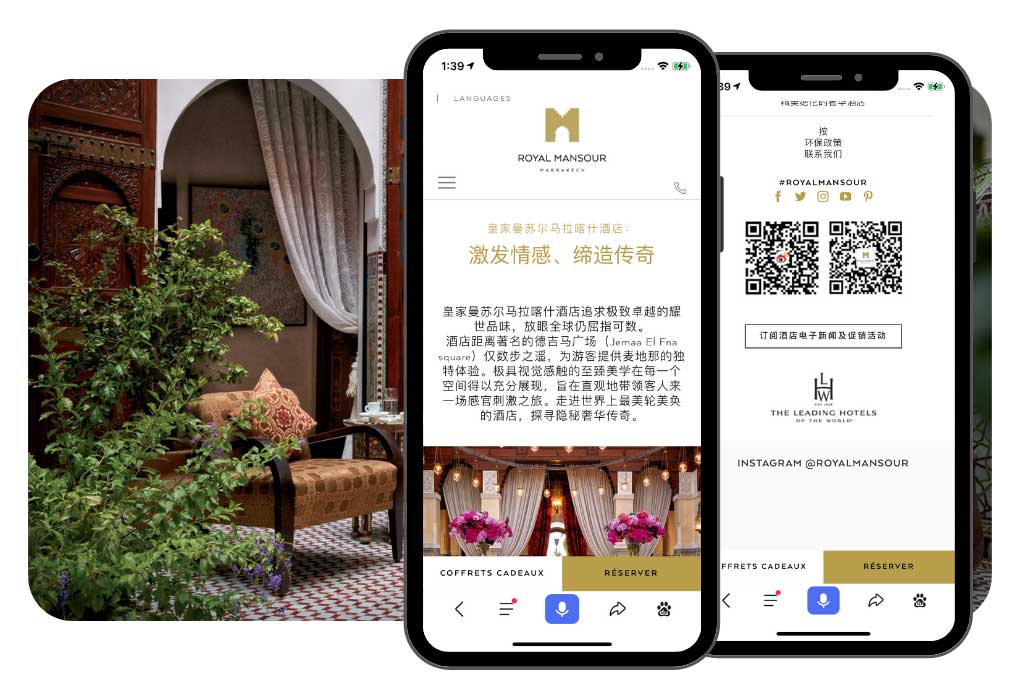
Royal Mansour Marrakech

Memories Travel

Do you need a partner to launch your travel agency or resort/hotel business in China? Contact us!
We help companies wishing to sell on the Chinese market. We are specialists in:
E-REPUTATION: Primordial before launching, we work together on your unique selling point, then on the social networks and with the help of PR, we make sure that your image on the networks is totally clean and reliable for the Chinese users.
SEO: The optimization of your referencing will be essential, our team of specialists will take care of your e-reputation, the management of your social networks while setting up an SEO / SEM campaign allowing you to gain places in the ranking of the Baidu Chinese search engine.
LEAD GENERATION: Our teams are professionals in lead generation. To optimize it, your e-reputation must be irreproachable. Investing in online advertising and creating quality content will help you develop your e-reputation. Finally, the evaluation of the results will be important to guide us in the next stages of your development.
DIGITAL SOLUTIONS: Website creation, development, and audit; social media marketing; PR; monthly reports and analyzes by our team of experts.






Great Article. You sum up every points. 😉
Thank you Mike.
They are now facing a major challenge from their increasingly well-traveled Chinese counterparts.
Not only are the Chinese bemoaning their rudeness at home and abroad, the government has responded with new rules that took effect this week, aimed at keeping loutish travelers in check.
+40% of Chinese tourists in UK
https://www.theguardian.com/business/2016/jan/27/chinese-tourist-numbers-coming-to-uk-up-nearly-40
More than 200,000 Chinese holidaymakers visited in first nine months of 2015 and £2,700 spend per head is among highest, says VisitBritain
Yes big opportunities for UK retaillers and hotels 🙂
Great article and nice tips for all Travel Agencies in the world.
thank you Eric for this comment. 😉
China travel, oh guys, everyone has a point of view … from my personal experience, I have not seen a lot of things that show that they are a lot of people suggest greedy, cunning, uneasy and disgusting people. The Thai government believes that the best thing is to bring China’s train from abroad to the country, the price is expensive.
In the past, many Chinese touristsdrove here, it seems that if there is any delay on the road, fouls, etc., then a Chinese car or minivan (more often) will decide to turn from the left lane, fully acceptable, or if A big crossroads missed a turn and they would only turn to the corner to continue, such a thing. Rent a motorcycle 10 organization on the whole road, the bike on the one hand trying to drive, or gathered at a big crossroads waving around the phone, all the right way to argue, is still pretty normal.
This middle class travel thing is quite fresh for the Chinese people, but I believe this information gradually starts uh …
The uggly part !
I have seen a lot of robbery, pushing earing curse the Chinese people, not pretty, plus I used in Australia A chef in a large resort, these groups will come here later in the afternoon, eat together, hit the gift shop, overnight, destroy the buffet and leave great food on the table. At the same time put all the fruit and pastry as a tour guide said the resort is stripping them so that whenever they get … so, blankets, pillows, bed sheets, remote control until the staff stopped doing so, the mini bar was cleared … until I locked the door of the kitchen, and I thought of a few people trying to roll through my fridge and blasted the buffet tray on the table because they were cleared by his Chinese guy. This is a few years ago the front line, when the travel thing is still a little new time. I doubt it will happen now.
The point is that everyone will eventually learn, even the cheapest Chinese farmers will learn such a good thing, let your wife put a garbage in the elevator, or sleep in a flower bed, I see here The young generation of Chinese people are very smart, buttocks, seem to be significantly low-key and polite.
Give you time, I think you will find that everyone can change
Hi,
I am Mehdi , marketing manager of Persia tourism group in Iran(Tehran).
Having 20 years experiencing in tourism industry , Main activity of the company is incoming tours from different countries. Our main office is in Tokyo and we are more familiar with Ancient characteristics of Ancient tourists. We would like to deal with Chinese outgoing tour operators.
We will be thankful if you guide us to link with Chinese travel agencies and tour operators.
i am doing transportation in sri lanka from 6 years. so far i am not dealing with chinese.so i need more help how to deal with chinese travel agency.how can i get to know
My name is Michele Moussalem, partner in LEISURETIMES.ORG,
I found your tips very useful. We would like to work with your organisation to attract Chinese tourists to Italy, more specific to our region Abruzzo.
Please check our website: http://www.leisuretines.org
Email: info@leisuretines.org
Waiting your email to take further this venture.
Regards
Waiting your
Regards
Can you send to me your Guide about “how to attract chinese tourists in 2019? please”
Do you know how many chinese tourists in the UK ? And how to target chinese tourists only for the UK?
Do you have the list of the top destinations for chinese tourists in 2019?
What do chinese tourists want when they travel?
I will send to you Mike. have a nice Day