How SEO&SEM can boost your Business in China in 2023?

How do you get traffic, leads and sales in China in 2026? The short answer used to be SEO plus SEM on Baidu. That still matters, but the game changed. On 2 July 2025 Baidu rebuilt search around AI, so a Chinese user often reads an AI-written answer before they ever see a single link or ad. To win traffic now you need three things working together: organic SEO, paid SEM, and a new piece called GEO, getting the AI to quote you. Here is how each part works and how a smaller brand can use them without burning the budget.
SEO & SEM are helpful tools to get more traffic and potential customers to your website. or a ECommerce platforms.
Cost-Effective Agency
KPI and Results focused. We are the most visible Marketing Agency for China. Not because of huge spending but because of our SMART Strategies. Let us help you with: E-Commerce, Search Engine Optimization, Advertising, Weibo, WeChat, WeChat Store & PR.
SEO&SEM are techniques which improving the visibility of a website or online store in search engines.
Due to the rise of the internet, companies are no longer restricted to selling their products offline. Online purchasing is a global phenomenon, and the users are willing to buy everything via internet. Nowadays, sell goods nationally or globally is easy thanks to online stores.
The first step to enjoy the benefits of an online store and sell your products, is create a professional quality website, because customers are far more likely to purchase if they feel the vendor is trustworthy.
Secondly, customers have to be able to find your e-commerce website. If users are searching for goods that you sell, but they can’t find your website, you are wasting a lot of potential buyers.
The importance of SEO: (organic results)
Definitely, search engines such Baidu are the best way in order to find products or services through internet and therefore, SEO plays a growing role in China.
Make an online marketing investment in China is very effective due to the really rocking advantages of SEO and its effectiveness.
Search Engine Optimization (SEO) is a service to improve the ranking of your website in the search engine result pages. In China, search engine optimization becomes more and more important. There is an important correlation between the search of the user into the search engine and the result page. The higher the relevance of your website, the number of visitors in your website will increase.
When customers are looking for products online in China, they will nearly always utilize Baidu as a search engine. That means that if you want that users are able to found your website and therefore, buy your goods, the website needs to be well situated in the search engines. SEO will help climb that ranking, ensuring your website is placed in front of potential consumers who are actively searching for the products that you sell.
That is the reason why SEO is the best way to improve your rankings and to boost your e-commerce.
Chinese trust more ORGANIC results that paid ads.
The importance of SEM: (ads )
SEM is also an online marketing technique in order to increase the number of interested consumers visiting your website from the search engine.
SEM or pay-per-click (PPC) is a form of paid advertising. This means the company only pay when people clicks on the advert. With PPC, you can select the keywords for the ad and also you can choose the price that you want to pay per click.
The price is flexible, you can choose how much to pay for each keyword and per click and another option is choose the maximum daily spend.
For example, if the customer write on the search engine the keyword that you have chosen and you have the highest bid for that keyword, your ad will appear in a prominent position.
By choosing concrete keyword, you can avoid showing your ads to users who are not interested to purchase them.
PPC on Baidu is the most effective online marketing method to reach the Chinese market because a large majority of Chinese people use Baidu as their main search engine. Baidu PPC allows you to save money and time and increase your benefits with a minimal investment.
SEO and SEM are two different but similar online marketing techniques which guarantee an increased volume of visitors in your website and therefore help you to increase the number of sales.
If you want to increase your web presence, improve website traffic and therefore boost sales for your e-commerce site, don’t hesitate to contact us.
Baidu in 2026: SEO, paid ads, and the new GEO
The big shift is AI. Since 2 July 2025 the old Baidu search bar is a “Smart Box” (智能框) that takes prompts over 1,000 characters plus uploads of files, images, audio and video. Above the normal links, Baidu shows an AI answer called Baikan (百看). Baidus assistant, renamed the Wenxin Assistant (文心助手) in October 2025, passed 200 million monthly users by January 2026. Baidu still holds about 47% of China search share, so it is still where you fight to be seen.
So how do the three tools fit together now? SEO still earns trust, because Chinese users trust organic results more than ads. SEM (paid PPC) still buys you fast, targeted visibility for the keywords that matter, and you control the daily spend. The new layer is GEO, generative engine optimization. The goal is to be the source the AI quotes in that Baikan answer box. You do that by keeping one consistent entity across Baidu Baike, your Baijiahao account and your own site, and by writing answer-first content that directly answers the question in the first line.
For a small or niche brand this is good news. You do not need to outspend the giants. You need to be the clearest, most consistent source on your topic. Our full Baidu SEO 2025 guide breaks down exactly how to do that on a startup budget.
Sources:
10 crucial SEO tips for e-commerce entrepreneurs.
Learn more about us and our Baidu SEO/SEM Services
If you need a Top Performing SEO or SEM agency, feel free to contact us.
Our rate are reasonable
And we perform, and can guaranty results.
The 2026 market reality: what the data shows
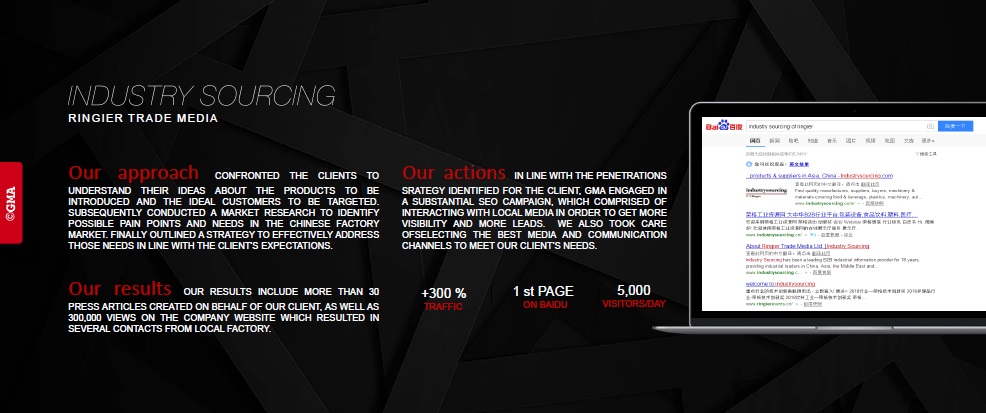
China’s search advertising market is bigger than most foreign brands expect. Digital ad spend in China reached US$140.97 billion in 2025 and is projected to hit US$163.10 billion by 2026, growing at 15.7% annually according to Research and Markets. Baidu controls roughly 58-64% of all search traffic in China as of early 2026, with mobile dominance at 77.86%, as tracked by StatCounter. For any foreign brand targeting Chinese consumers, ignoring Baidu SEO and SEM means ignoring the largest search advertising market on earth. The opportunity is real, but the rules are different from anything you know in Western markets.
Why Baidu SEO works differently from Google
Most foreign marketing teams assume their Google playbook transfers to China. It does not. Baidu has a distinct algorithm, a different content preference system, and a set of technical requirements that will block your site entirely if you ignore them.
First, there is the ICP beian requirement. Any website hosted on mainland China servers must have an ICP license issued by the Ministry of Industry and Information Technology. The process takes 4 to 8 weeks. Without it, your site either loads slowly behind the Great Firewall or does not load at all. Baidu deprioritizes slow sites. If your page takes more than three seconds to load on a Chinese mobile connection, you lose rankings regardless of your content quality.
Second, Baidu reads Simplified Chinese content far better than it reads English. Pages written in English rank poorly for Chinese-language queries, even when the topic is directly relevant. Foreign brands that invest in professional Simplified Chinese content consistently outperform those that rely on translated versions of their international sites.
Third, Baidu’s algorithm now runs on a 90-day content freshness window, tightened in 2025 after DeepSeek integration changed how Baidu evaluates content quality. Pages not updated within three months show declining rankings even when their backlink profiles remain stable. This is a sharp departure from Google’s longer evaluation cycles. For B2B companies in sectors like manufacturing, chemicals, or industrial equipment, this means your product pages need regular updates, not just a one-time optimization pass.
Fourth, Google dependencies break your China site. If your pages call Google Fonts, Google Analytics, or reCAPTCHA, those scripts fail in mainland China. The result is a slow, partially broken page that Baidu will not rank well. Auditing your site for these dependencies before any China SEO campaign is non-negotiable.
Baidu’s app is installed on over 724 million monthly active devices as of early 2026, according to Search Engine Land. That is your organic traffic opportunity, but only if your technical foundation is correct.
Baidu SEM: paid search that still converts
Baidu SEM, called Baidu Tuiguang (百度推广), is the platform’s pay-per-click advertising system. It operates on a similar auction model to Google Ads, but the specifics matter for budget planning.
Average cost-per-click on Baidu ranges from US$0.30 to US$1.20 for most keywords. Competitive categories like medical devices, financial services, and luxury goods can push CPCs above US$20 per click. Foreign brands entering the platform for the first time need a minimum pre-paid ad credit of around US$1,500 plus initial setup fees. This makes Baidu SEM accessible to mid-size companies, not just large multinationals.
A concrete example from the industrial sector: a German industrial pump manufacturer ran a Baidu SEM campaign in 2024 targeting procurement managers in Shanghai, Guangzhou, and Chengdu. By running ads in Simplified Chinese with landing pages hosted on a .cn domain, they reduced their cost-per-lead by 38% compared to their previous approach of sending Chinese visitors to their German site. The Baidu campaign generated more qualified inbound inquiries in four months than their international trade show presence did in a year.
Baidu SEM also gives you speed that organic SEO cannot match. New entrants to the Chinese market can be visible in Baidu search results within days of setting up an account, provided they clear the account verification process. Baidu requires foreign companies to provide business registration documents, a Chinese business contact, and in some cases a local Chinese entity or distributor to act as the account holder. Working with a certified Baidu partner agency cuts this verification time significantly.
B2B companies in particular should note what Search Engine Land’s 2026 analysis found: B2B companies investing in Baidu SEO generate more qualified leads and higher conversion rates than comparable companies in the UK or Germany. The traditional web search funnel in China remains highly effective for considered purchases, even as social platforms grow.
What changed between 2024 and 2026
The two-year period from 2024 to 2026 produced more change in China’s search landscape than the previous five years combined.
The biggest shift is AI integration. Baidu launched its AI Overview feature in January 2025, powered by ERNIE Bot. By January 2026, ERNIE Bot had crossed 200 million monthly active users, as announced by Baidu. This feature shows AI-generated answers at the top of search results, above organic listings. The knock-on effect: over 70% of Chinese search queries now result in zero-click journeys, where users read the AI answer without visiting any website. This matches what The Egg documented in its 2026 research on Baidu behavior shifts.
DeepSeek’s launch in early 2025 accelerated this further. Baidu integrated DeepSeek-style reasoning models into its ranking signals. Content strategy shifted from keyword density to what practitioners now call entity seeding: building a documented, citable brand presence so that AI systems cite your brand when answering user questions.
Haosou, operated by Qihoo 360, also grew its share to 18.17% by April 2026, up from near-irrelevance two years prior. Bing dropped over 20 percentage points after Microsoft reduced AI features for the Chinese market. The competitive map changed fast.
For SEM, Baidu tightened ad policies around health claims, financial products, and educational services following 2024 regulatory actions from the Cyberspace Administration of China. Brands in these sectors now require additional documentation before campaigns go live.
Frequently asked questions
How long does it take to see results from Baidu SEO?
Baidu SEO results typically appear within three to six months for new sites, assuming technical requirements are met from the start. The ICP beian filing alone takes four to eight weeks. After that, Baidu crawls new pages relatively slowly compared to Google. The 90-day content freshness window introduced in 2025 means you need to publish or update content consistently to maintain momentum. Sites with solid Simplified Chinese content, correct technical setup, and a local .cn domain or CDN tend to see meaningful ranking gains within four months. For highly competitive keywords, budget six to twelve months. SEM can fill the gap while SEO builds up.
Do foreign companies need a Chinese entity to advertise on Baidu?
Foreign companies can run Baidu SEM campaigns without a Chinese entity, but the process is more complex. Baidu requires business registration documents in Chinese, a verified Chinese phone number, and a local contact. Many foreign brands work through a certified Baidu partner agency that holds the account on their behalf. Having a WFOE (Wholly Foreign-Owned Enterprise) or a local distributor as the account holder simplifies verification and increases daily budget limits. The minimum ad deposit is around US$1,500. Organic SEO does not require any Chinese entity, though an ICP-licensed hosting setup still needs a local partner or data center arrangement.
Is Baidu SEO worth it now that social platforms dominate China?
Yes, particularly for B2B companies and high-consideration consumer purchases. Social platforms like Xiaohongshu and Douyin drive discovery for lifestyle, beauty, and food categories, but when Chinese buyers research industrial equipment, software, or professional services, they use Baidu search. Research consistently shows that B2B companies with active Baidu SEO programs generate more qualified leads per dollar than their Western counterparts do on Google. The zero-click trend is real, but it affects informational queries more than transactional ones. Someone searching for a specific pump model or software vendor on Baidu is ready to buy. That traffic still converts well.
What is GEO and why does it matter for China search in 2026?
GEO stands for Generative Engine Optimization. It refers to the practice of structuring your content so that AI search systems cite it when answering user questions. With Baidu ERNIE showing AI-generated answers at the top of results, the goal is no longer just ranking on page one. It is being cited inside the AI answer itself. This requires structured content with clear topic sentences, verifiable data points, and citable sources. Brands that have optimized for GEO in China report stronger brand association even when direct traffic drops due to zero-click results. GEO is not a replacement for traditional SEO but an addition to it, specifically targeting the AI layer that now sits above organic listings.
How to move forward
If you are a foreign brand entering China search marketing, start with your technical foundation. Get ICP beian sorted, remove Google dependencies, and set up a fast local hosting solution. Then build Simplified Chinese content around the queries your buyers actually use on Baidu.
Run Baidu SEM in parallel from day one. Paid search gives you visibility while organic rankings build. Use the SEM data, actual click rates and query patterns, to guide your SEO content calendar.
Beyond search, integrate your SEO and SEM efforts with your broader China presence. Baidu ranks your site higher when it sees consistent brand signals across Chinese platforms: Zhihu articles, Weibo mentions, WeChat public account content. These are not separate activities. They feed each other.
For search specifically, work with specialists who know the Baidu ecosystem: a China SEO agency for organic growth and a Baidu advertising partner for paid campaigns. If your product has a visual or lifestyle angle, layer in Xiaohongshu and Douyin to capture social search traffic that does not appear in Baidu at all.
If you want an honest assessment of where your current setup stands and what it would take to rank and convert in China, get in touch with us here. We review your site, your target keywords, and your competitive position before recommending anything.
Marcus Zhan is a China marketing specialist based in Shanghai. He covers digital marketing, consumer trends, and brand strategy for the Chinese market. Connect with him on LinkedIn for China SEO and SEM insights.
Sources: Research and Markets, China Digital Ad Spend 2026 | StatCounter, China Search Engine Market Share | Search Engine Land, China Fragmented Search Ecosystem 2026 | The Egg, How Baidu AI Search Is Changing Marketing in China | TechNode Global, How DeepSeek Changed Baidu SEO Rules 2026