1.125 Billion Internet Users in China (2026 update)
- The “1.68 billion mobile users” figure was always wrong. Here are the real 2026 numbers from CNNIC, China’s official internet body.
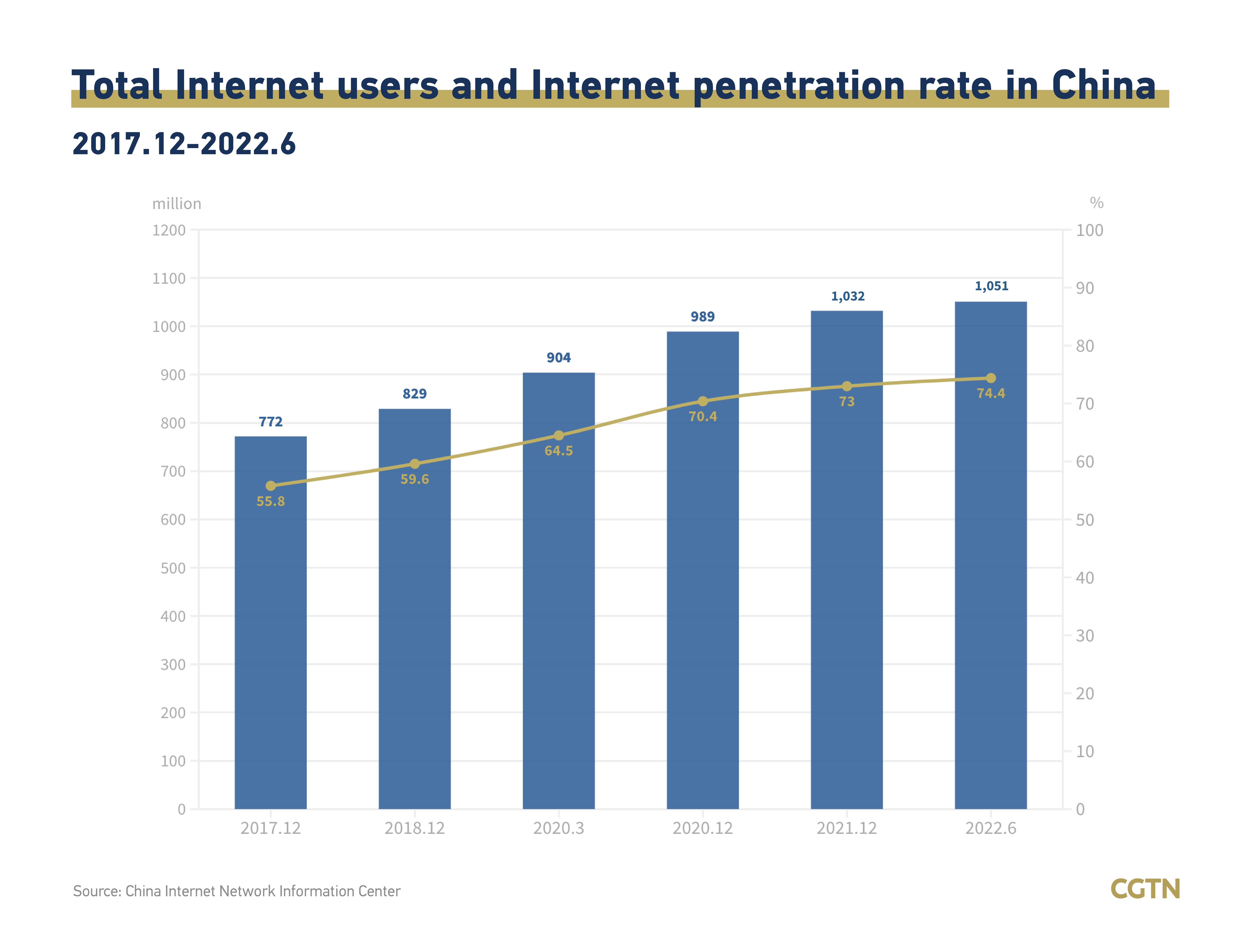
- China had 1.125 billion internet users at the end of 2025, a penetration rate of 80.1%.
- 1.116 billion of them go online on mobile, which is 99.4% of all internet users. China is, in practice, a mobile-only internet country.
- Generative-AI users reached 602 million by December 2025, up 141.7% in a single year.
What near-total mobile penetration plus AI means for brands in 2026
When 99.4% of a country’s internet users are on mobile, “mobile-first” is no longer a strategy, it is the only reality. For a brand this means three things. Your Chinese site and shop must load fast and look right on a phone, full stop. Your content has to be made for vertical screens and quick reading. And your buying journey, from discovery to payment, has to happen inside the phone without a single desktop step.
The bigger shift is AI. With 602 million generative-AI users by the end of 2025, Chinese consumers now ask an AI for recommendations the way they used to type keywords. Baidu rebuilt its search around this on 2 July 2025, putting an AI answer above the normal links. So getting found is no longer only about ranking. It is about being the trusted source the AI quotes. Brands that keep one consistent story across their site, social profiles and platforms like WeChat will win that quote.
Cost-Effective Agency
KPI and Results focused. We are the most visible Marketing Agency for China. Not because of huge spending but because of our SMART Strategies. Let us help you with: E-Commerce, Search Engine Optimization, Advertising, Weibo, WeChat, WeChat Store & PR.
WeChat sits at the center of this mobile life, where chat, content, mini-programs and payment all live in one app. If you want to understand how to build there, read our deep analysis of Tencent’s WeChat ecosystem.
Statistics in China
China represents, by itself, most of the worldwide mobile users. On December 2022 , Chinese mobile broadband subscribers hit 99% of the total amount of mobile users. Recently, according to the Ministry of Industry and Information Technology (MIIT) of the Chinese government, 1.116 billion Chinese people use the internet on their smartphones. However, this growth seems to slow down a little bit since the beginning o.
Mobile broadband (5g) subscribers in China.
Crazy figure Connections in China will be 5G by 2025. Between 2020-2025 88% of operator capex will be invested in 5G equivalent to $116.16bn
the 5G users amount kept growing with a growth of more than 600 millions of users. China is ready to move on to a faster internet connections. The three telecom giants of China (China Telecom, China Unicorn and China Mobile) were handed over 5G licences and they were given permission to operate the own Chinese 4G services within the country. This will sure help to faster internet over the next few years.
Digital Marketing and services will play a fundamental role in the Chinese Economy (afetr Covid-pandemic)Interested by the Chinese market ? Everything is happening online (in 2023)All innovative brands models for Comapnies and new experiences for consumers. Recognising the opportunity that digital advancement can bring to society,
- Chinese goverment in China has taken steps to implement enabling policies for cost-effective infrastructure deployment.
- In January 2022, the MIIT exaplained that Mobile operators in mainland China had launched more than 1.4 million 5G base stations,
- Big play : triple the number of 5G base stations to 3.64 million by the end of 2025.
How to make digital your weapon in China?
The usage
Since a few years now, it has been developed new online payment systems to increase and make the online shopping easier. Those systems allows customers to have access to banking services anywhere, at any time. Thanks to that, users can check their bank status, make bank operations or pay whenever they need, wherever they want.
This penetration of mobile payments systems has changed the purchasing habits of Chinese online consumers, now most of them make purchases via their smartphones.
Chinese uses mobile broadband mostly to go on social networks like the most popular messaging app in China, WeChat but also to watch TV, movies or dramas. Also, Chinese consumers spend a lot of time and money on mobile games which help to increase the use of mobile broadband.
The mobile internet market
In China, most pages viewed on Internet are viewed via mobile devices. It helped to create a new way for compagnies to attract consumers and thus to build a new market.
According to a 2012 report released by Baidu, more users access the Internet via mobile device around 8 AM in the morning and 10 PM at night. It shows the mobile advantage “wherever and whenever” which permit to people to stay connected 24/7 and to compagnies to catch the attention of consumers by using different ways, at any time.
Internet giants, with website using responsive design can reach a greater number of people, from the biggest cities like Beijing to the most remot corner of Yunnan.
Will digital marketing have to change its name into mobile digital marketing? Longer but definitely closer to the truth. If you want to know more about how to take advantage of this, contact us!
Baidu is mobile friendly now
Latest SEO news on seoagencychina
Follow us on LINKEDIN
We are a Leading Digital marketing agency in China
https://seoagencychina.com/digital-agency-shanghai-china/ Contact us for more information about Digital Soltion to sell in ChinaChinese E-Commerce Agency in Shanghai, Beijing , ShenzhenNow I have enough real data to write the article. Let me compose the full Gutenberg HTML block.
The 2026 market reality: what the data shows
China closed 2025 with 1.125 billion internet users and an internet penetration rate of 80.1%, according to the China Internet Network Information Center (CNNIC). That figure represents a jump of 1.1 percentage points in penetration in a single half-year. Rural internet penetration reached 69.5% by end-2025, up 13.6 percentage points over the entire 14th Five-Year Plan period. The sheer scale changes what digital marketing in China means: you are not reaching a niche online audience. You are reaching the majority of a 1.4-billion-person country.
Where those 1.125 billion users spend their time
Raw headcount tells only part of the story. The more useful question for any brand entering China is: where do those users actually go, and what do they do when they get there?
Short video dominates daily attention. Douyin alone reported 766.5 million monthly active users inside China in 2025, with 83% of all Chinese internet users active on the platform. Average daily use across mobile apps in China reached 7.97 hours per day by mid-2025, up 7.8% year-on-year. Sessions per day averaged 117.9, which means users are not sitting through long content blocks. They are picking up and putting down their phones dozens of times daily, browsing short clips, live streams, and social feeds.
WeChat remains the connective tissue of digital China. With over 810 million users in China and roughly 954 million monthly active users of its Mini Programs, WeChat is not just a messaging app. It is a browser, a payment system, a customer service channel, and a loyalty programme, all in one. Chinese users spend an average of nearly 80 minutes per day on WeChat alone.
Live commerce is now a standard purchase channel, not a novelty. Douyin’s live shopping accounted for 40% of its ecommerce revenue in 2025. Livestream shopping in China as a whole is on track to cross $1.1 trillion in gross merchandise value by 2026. The format shifted further: 70% of ecommerce livestreams on Douyin are now run by merchants directly, not by third-party influencers. Brands that still treat live commerce as an “influencer marketing” line item are misreading the channel.
Search behaviour is also fragmenting. Baidu remains the default search engine for transactional and informational queries, but younger users increasingly search inside Douyin, Xiaohongshu (Little Red Book), and WeChat. A brand with no Baidu presence is invisible to one segment. A brand with no Douyin or Xiaohongshu presence is invisible to another. Neither absence is acceptable if you are serious about China.
What the AI wave means for brands targeting Chinese consumers
The number that surprised most analysts in the CNNIC end-2025 report was not the internet user total. It was the generative AI figure: 602 million users of generative AI products in China by December 2025, up 141.7% from end-2024, with a national adoption rate of 42.8%. No other major market has moved that fast on AI consumer adoption.
What does this mean in practice for foreign brands? Chinese consumers are increasingly using AI tools to research products, compare prices, translate foreign content, and make purchase decisions. If your brand content is not machine-readable and context-rich, AI search surfaces will not surface you. This is a direct pressure on content quality and structure.
On the platform side, Alibaba, ByteDance, Tencent, and Baidu are all embedding AI into their ad-serving and recommendation engines. China’s digital ad market is expected to reach $163.1 billion in 2026, growing at 15.7% annually, according to GlobeNewsWire research. Alibaba, Tencent, and ByteDance capture the majority of that spend. Baidu holds the search segment. Advertisers who understand how each platform’s AI auction works will pay less for better placement.
A concrete example: L’Oréal China leaned into AI-generated product tutorials on Douyin in 2024 and 2025, pairing them with live commerce sessions anchored by store staff rather than celebrity KOLs. The result was a cost-per-acquisition that tracked below celebrity-KOL campaigns while maintaining consistent brand messaging. The brand used Tmall’s AI personalisation tools to serve different SKU recommendations to users based on skin-type data collected via a WeChat Mini Program quiz. The lesson is not that AI replaces human content creators. The lesson is that AI tools now shape which content reaches which buyer at what moment, and brands that ignore this lose ground to competitors who do not.
For SEO specifically, Baidu has integrated AI-generated answers into its search results pages since 2023. A page that answers specific questions directly, with structured data and locally hosted content, performs better than a page that buries the answer in long paragraphs. This is true in every market now. In China it is especially true because Baidu’s crawler prioritises speed and local hosting, and because the AI summary layer draws from pages with clear H2/H3 structure and factual density.
What changed between 2024 and 2026
Several things shifted in the 2024-2026 window that directly affect how foreign brands should plan their China digital strategy.
First, the regulatory environment tightened on data. The Network Data Security Management Regulations that took effect on January 1, 2025 strengthened data localisation rules. Critical data must be stored inside China. Cross-border data transfers require security assessments. For brands running global CRM or analytics platforms, this created real compliance friction. Brands that had not localised their data infrastructure by early 2025 faced hard choices: delay China campaigns or operate without the consumer data they rely on elsewhere.
Second, the ecommerce competitive map shifted. Taobao, Tmall, and JD.com still control close to 70% of gross merchandise value when combined with Pinduoduo, according to GlobeNewsWire’s 2026 B2C Ecommerce Market Report. But Douyin and Kuaishou are pulling traffic away from the traditional search-and-buy model. Brands that ran China ecommerce purely through Tmall in 2022 now need a live-commerce presence on Douyin to compete for the same consumers.
Third, rural China came online at scale. Rural internet penetration rose from below 60% in 2020 to 69.5% by end-2025. This added hundreds of millions of users who have different purchasing habits, different price sensitivities, and different platform preferences compared to urban consumers in Shanghai or Beijing. Pinduoduo built its entire model around this demographic. Foreign brands that assumed China’s internet audience was primarily urban, young, and affluent need to revise that picture.
Fourth, generative AI adoption by consumers jumped faster than any platform predicted. 602 million AI users by end-2025 means AI-assisted search and shopping is now mainstream, not early-adopter behaviour. This changes the content game and the SEO game simultaneously.
Frequently asked questions
How many people use the internet in China in 2026?
China reached 1.125 billion internet users at the end of 2025, with an internet penetration rate of 80.1%, according to the CNNIC. Mobile internet monthly active users stood at 1.267 billion by mid-2025, meaning many users have multiple connected devices counted separately. The 1.125 billion figure is the most cited benchmark for total internet users. Rural penetration reached 69.5% at end-2025, up sharply from earlier in the decade. Urban penetration is substantially higher. China represents roughly 14% of the global population but accounts for close to 20% of the world’s internet users. For any brand with global ambitions, this is the single largest addressable digital market on the planet.
Which platforms do Chinese internet users spend the most time on?
Douyin leads in daily time spent among short-video and social commerce platforms, with 766.5 million monthly active users in China and an average session structure built around short, algorithm-served clips. WeChat follows as the dominant messaging and lifestyle super-app, with over 810 million users in China spending close to 80 minutes per day on the platform. Tmall, Taobao, JD.com, and Pinduoduo dominate product search and purchase. Xiaohongshu (Little Red Book) is especially important for beauty, lifestyle, and premium consumer goods. Baidu handles the majority of traditional web search. A complete China digital presence typically requires at least three or four of these platforms working together, because no single app covers every stage of the consumer journey.
Can foreign brands sell directly to Chinese consumers online?
Yes, through two main routes. The first is cross-border ecommerce (CBEC), which allows foreign brands to sell into China without a local entity, using bonded warehouses or direct overseas shipping. Platforms like Tmall Global and JD Worldwide operate under this model. The second is setting up a local entity and selling through standard domestic ecommerce channels, which gives access to Tmall, Taobao, JD.com, and Douyin Shop. The CBEC route is faster to launch but comes with customs duties and product restrictions. The local entity route takes longer but gives full access to domestic marketing tools and logistics. Both routes require compliance with China’s data and consumer protection regulations. Most brands start with CBEC and move to local entity once they have validated demand.
Does Baidu SEO still matter when Chinese users search on Douyin and Xiaohongshu?
Yes, Baidu SEO still matters, and the two approaches complement each other rather than compete. Baidu handles high-intent transactional and informational searches, especially from older demographics, B2B buyers, and users researching major purchases. Douyin and Xiaohongshu handle discovery and social proof, especially for consumer goods and lifestyle categories. A foreign brand targeting China needs both. Baidu SEO builds a permanent organic presence that compounds over time. Douyin and Xiaohongshu content drives shorter bursts of awareness and purchase intent. Brands that invest only in social platforms build audience that disappears when algorithm reach drops. Brands that invest only in Baidu miss the discovery phase where many Chinese consumers first encounter a product. The right strategy allocates budget to both, adjusted for your category and target demographic.
How to move forward
If you are a foreign brand looking at 1.125 billion Chinese internet users and trying to figure out where to start, the answer depends on your category, your budget, and your timeline. But some steps apply across almost every situation.
Start with search visibility. A Baidu advertising presence captures in-market demand immediately while organic SEO builds over the medium term. Work with an SEO agency that understands the Baidu algorithm and local hosting requirements. Do not rely on Google-optimised content: Baidu crawls and ranks differently.
Build social proof on the platforms where your buyers research. For consumer goods, this means Xiaohongshu and Douyin. For B2B, WeChat is the primary channel for content distribution and relationship-building.
Decide on your ecommerce route early. Tmall and Taobao give access to China’s largest shopping audience. Pair that with a live commerce strategy on Douyin to capture the content-driven purchase behaviour that is growing fastest.
If you need guidance on where to start or how to prioritise, get in touch with the team. The market is large enough that there is room for well-positioned foreign brands. The question is execution.
Marcus Zhan is a China marketing specialist based in Shanghai. He covers digital marketing, consumer trends, and brand strategy for the Chinese market. Connect with him on LinkedIn to discuss China digital strategy.
Sources: CNNIC via China.gov.cn, February 2026 | GlobeNewsWire, China Digital Ad Spend Report 2026 | GlobeNewsWire, China B2C Ecommerce Market Report 2025-2029 | DataReportal, Digital 2026: China