
Where Chinese buy overseas properties?

Cost-Effective Agency

KPI and Results focused. We are the most visible Marketing Agency for China. Not because of huge spending but because of our SMART Strategies. Let us help you with: E-Commerce, Search Engine Optimization, Advertising, Weibo, WeChat, WeChat Store & PR.

Chinese buyers are back in the overseas property market, but the map has changed since 2023. Activity has been recovering since 2024, and the reason to buy has shifted. Only about 3% of buyers in 2024 named emigration as their main goal, down from 11% in 2019. Today roughly 94% buy for personal or family use, a home, a school base for their kids, or a lifestyle investment. Borders are open and wealthy Chinese can travel and view property anywhere.

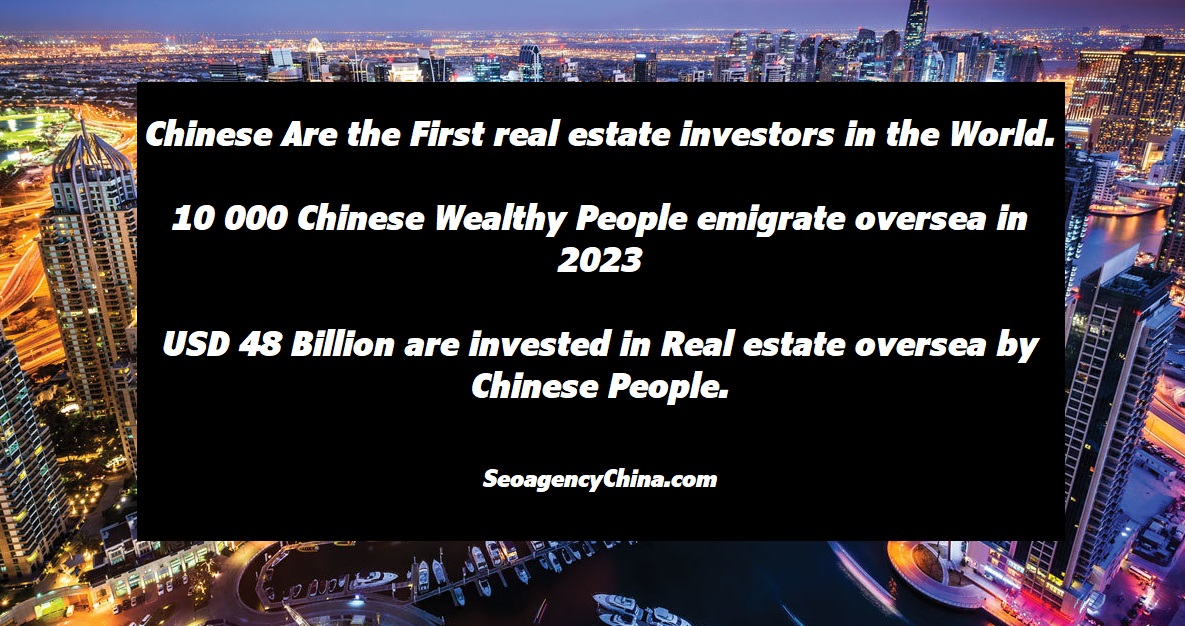
Recent news explain that more than 10,000 Super Rich Chinese are expected to relocate from China to Popular destination like Singapore, Dubai, Europe, USA and Canada. Experts from Henley & Partners estimated than US$48 billion, will be invested following this migration .

Where Chinese buyers are active in 2025 and 2026

The destinations have moved. Southeast Asia now leads. As of 2025, Thailand has overtaken the United States as the most popular target, with Bangkok alone taking about 38% of sales, followed by Pattaya, Phuket and Chiang Mai. Malaysia has climbed to second place in Southeast Asia, ahead of Vietnam, and around 60% of Chinese buyers there buy for investment.

The United States is still big money. Chinese buyers spent about US$13.7 billion on US homes between April 2024 and March 2025, an 83% jump on the year before, and California stayed the top US state for them. Thailand, the UAE (Dubai and Abu Dhabi), Japan and parts of Europe round out the short list. The clear pattern through 2025 is a shift toward Asia-Pacific markets that are closer, cheaper to enter and seen as more predictable.

One thing has not changed: research starts online. Chinese buyers and people planning to migrate now do a lot of that research on Xiaohongshu (RED), where real owners post honest reviews of neighborhoods, schools and developers. If your project is not shown there with real photos and real answers, you are invisible to this group. See our Xiaohongshu marketing guide for 2026 for how to be found.

Where Chinese buy overseas properties?

Devaluation of the yuan last year, raise of the middle class, Chinese slowdown economy, all these factors are actually leading Chinese to invest more in properties abroad. Here our topic can actually cover two different sides that we will explain further in this analysis below.

  • The first question that remains is in which countries Chinese are investing their money?
  • The second question is where the Chinese find their overseas properties?

Chinese real estate investors lose “trust” in The Real estate in China.

The pandemic and a tightening of regulations have weakened the real estate sector, which is essential for the Chinese economy.
China will ease the financing conditions for certain real estate developers, in order to revive a key sector of the economy weakened by the pandemic and a tightening of regulations, according to Xinhua

Access to credit for developers has shrunk considerably since 2020, when the authorities began to impose prudential ratios to reduce their reliance on borrowing.

Chinese investors are still looking for overseas options in 2026.

Top 4 of countries where Chinese Wealthy People decide to buy overseas properties

The USA is still one of the most searched property markets for Chinese people, with about US$13.7 billion spent on US homes in the year to March 2025. The main reason here is because the Chinese feel that the USA is a safe place to pour and invest their money in.

Adding to this, the Chinese can easily avoid rules and barriers passing by Shenzhen and transferring money from China to Hong Kong. The second market is Australia, the country is not only attracting Chinese tourists but also Chinese investors.

First, Australia’s lifestyle, easy access to visa facilities, and potential profits lead the Chinese to invest more in Australia. Second, more Chinese people want their children to go to study in Australian schools so it can be an easier way for them to invest in Australian properties.  Third, in Australia, you can actually find more interesting properties at a lower price than in the biggest cities of China. Canada and United Kingdom are placed at the third position.

The UK is like a gateway to enter Europe for Chinese people and contrary to other European countries, UK is more opened to foreign investment and is offering mature building infrastructures for Chinese investors. Canada is offering a nice Canadian lifestyle to Chinese people, moreover, the Chinese community in Vancouver is huge. Canada is a country ranked in high return if investments for Chinese.
Dubai is also a promicing destination for Real estate investors, because of the emirate’s popularity with business circles, with Abu Dhabi now drawing buyers too.

Canada is a friendly country for Chinese People and a lot of community of Chinese already live in West Canada.

Where Chinese find their overseas properties?

Most Chinese people are looking on official websites to get more information and above all to test the company’s expertise in its field. Another trend is concerning Chinese customers who are looking for this “opportunity” and especially through social network channels (QQ, Wechat…etc.).

Read our Guide to Chinese Real Estate Investors

Expert Tips (seoagencyChina.com)

  1. There are lot of forum and investment discussion area on the Chinese Internert
  2. Baidu is the Chiense google. You have to get a website with good attractive Pictures to look credible (and in Chinese)
  3. Zhihu the Q&A platform where 100 000 questions about investment are listed.
  4. Douyin is like Tiktok . It is a perfect place for Explaining with video the intest of a destination and offer of each property developpers in 2023.
  5. Media about finance, real estate are a good way for Real estate firms to communicate about their Last project and ROI.

The opportunity will be a good price, a good place, and at the right time for the Chinese consumers in 2023.

They are using this social media tool to compare offers and get feedback from social media users. Besides this social aspect, overseas properties companies are trying to optimize more and more mobile tools, since users are browsing properties platforms using their mobile.

Read more

SEO Agency China (SAC): lead generation for real estate firms targeting Chinese buyers

We can help you to

  • Launch your Website to lure Chinese investors
  • Create SEO – SEM campaign on Chinese Search Engine
  • Work on your online Reputation
  • Communicate on Chinese forums, Q&A
  • Work with Chinese Media
  • Advertise on Chinese social Media

I now have enough real data to write the article. Let me compile it.

The 2026 market reality: what the data shows

Chinese buyers remain the largest single group of foreign real estate investors in the United States. Between April 2024 and March 2025, they purchased 11,700 U.S. homes worth $13.7 billion, representing 15% of all foreign buyer activity in the market. In Dubai, Chinese investors now account for roughly 14% of all foreign property purchases, drawn by rental yields above 7% and 10-year residency visas. At the same time, Chinese buyers in Thailand purchased over 6,600 condominiums in Bangkok, Pattaya, and Phuket in a single year, making China the dominant buyer nationality in Southeast Asia’s largest condo market. The geography of Chinese overseas property investment has never been more spread out, and the motivations driving it have shifted considerably since 2019.

The United States: still the top destination by dollar value

The United States holds a unique position in Chinese overseas property buying. No other market attracts as much money in absolute terms. The National Association of Realtors confirmed that Chinese buyers spent $13.7 billion on U.S. residential real estate between April 2024 and March 2025. That figure jumped 83% compared to the prior year, when Chinese buyers spent $7.5 billion. California alone captured 36% of all Chinese purchases in the country.

What drives this? Three factors repeat consistently in buyer surveys and agent interviews. First, education. Chinese families buy near universities in Los Angeles, San Francisco, and the Bay Area to secure housing for children studying in the U.S. A property purchase is treated as a long-term housing solution, often cheaper than years of rent. Second, wealth preservation. The domestic property market in China went through a severe correction after 2021. Buyers who watched developers like Evergrande default on obligations wanted assets held outside the yuan-denominated system. U.S. residential property, especially in supply-constrained coastal cities, offered that. Third, immigration optionality. Even though only 3% of Chinese overseas property buyers in 2024 stated emigration as their primary goal (down from 11% in 2019), many more keep the door open by establishing a residential foothold before committing to a visa pathway.

The average purchase price paid by Chinese buyers in the U.S. sits well above the market median. Chinese buyers tend to pay in cash: the NAR report noted foreign buyers overall closed 47% of transactions in cash, compared to 28% among all buyers. Chinese buyers skew even higher on cash purchases, which makes them competitive in bidding situations and allows them to close faster in markets where financing delays cost deals.

Florida, Texas, and New York round out the top states after California. The profile varies: Florida attracts buyers seeking a second home and rental income. New York draws buyers tied to finance and luxury residential. Texas is newer on the map but gaining traction as prices in California push buyers to look at comparable school districts and lower taxes in cities like Austin and Houston.

Southeast Asia: Thailand leads, Malaysia rises

Southeast Asia is where Chinese buyers have the deepest presence relative to local market size. Thailand is the clearest example. Chinese nationals purchased approximately 6,600 condominiums in Thailand in a single year, with a combined value of around $925 million. Bangkok accounted for 38% of sales, with Pattaya and Phuket splitting most of the remainder. At peak, Chinese buyers represented 46% of all foreign property sales in Thailand.

The appeal is straightforward. Thailand requires no permanent residency to purchase a condominium unit (as long as foreign ownership stays below 49% of any single building). Prices per square meter in Bangkok remain a fraction of Shanghai or Shenzhen. Flight time from major Chinese cities is two to four hours. And Thailand has actively courted Chinese buyers through Mandarin-speaking agents, Chinese-language property portals, and developer marketing campaigns targeted specifically at the mainland market.

That said, the market slowed entering 2025 and 2026. Colliers projects Chinese transaction volumes in Thailand will remain 30 to 35% below 2019 levels through 2027. Two issues explain the gap. The domestic Chinese economy put pressure on middle-class household wealth, reducing the pool of buyers who can commit to a foreign purchase. And some buyers who purchased in 2018 to 2021 found themselves holding properties they could not easily sell or rent, creating negative word of mouth in buyer communities on WeChat and Xiaohongshu.

Malaysia moved into second place in Southeast Asia, overtaking Vietnam. Chinese investors poured RM31 billion into Malaysia in 2024, more than double the prior year figure and the second-largest inflow of Chinese capital into Malaysia on record. Iskandar Malaysia in Johor, directly across the causeway from Singapore, remains the most active cluster. Buyers there get proximity to Singapore’s schools and infrastructure at Malaysian prices, which is a practical calculation many Chinese families with Singapore ties or work permits make explicitly.

Vietnam slipped from second to third. Regulatory uncertainty around foreign ownership rules and unfinished projects from developers who overextended during the 2020 to 2022 boom pushed cautious buyers toward Thailand and Malaysia instead.

Dubai and the Gulf: the fastest-growing destination

Dubai was not on most Chinese buyers’ shortlists before 2020. By 2025, China represents 14% of all foreign property purchases in the emirate, placing it third behind India and the UK. The shift happened fast and was driven by a specific combination of factors that Chinese buyers respond to well.

Rental yields in Dubai run between 6% and 8% on residential property, which is significantly higher than what buyers earn in the U.S., Japan, or Western Europe. The tax environment is simple: no income tax, no capital gains tax, no property transfer tax beyond a 4% registration fee. And the UAE introduced a 10-year Golden Visa tied to property purchases of AED 2 million or above (approximately $545,000). For a Chinese buyer who wants a second residency without committing to emigration, that structure is attractive.

Chinese buyers in Dubai concentrate in Downtown Dubai, Business Bay, Dubai Creek Harbour, and branded residential towers developed by Emaar, Sobha, and Damac. Off-plan purchases dominate: developers offer payment plans structured around construction milestones, which allows buyers to commit with lower initial capital.

The surge in Chinese interest in Dubai also reflects geopolitical calculation. U.S. property ownership became politically complicated for some Chinese buyers after 2022, as several U.S. states passed or considered legislation restricting Chinese nationals from purchasing near military installations or agricultural land. Dubai has no such restrictions and actively courts Chinese investment through dedicated real estate roadshows in Beijing, Shanghai, and Chengdu.

What changed between 2024 and 2026

Several clear shifts mark the 2024 to 2026 period compared to what came before.

First, motivations changed. The 2024 buyer survey data shows emigration fell to 3% as a stated primary motivation, down from 11% in 2019. Investment and asset diversification replaced it as the lead driver. Chinese buyers are not leaving China. They are placing capital outside China’s property market, which saw some of the sharpest corrections in a generation among tier-1 and tier-2 cities.

Second, the buyer profile shifted. The typical 2019 buyer was a first-generation entrepreneur or senior professional with accumulated savings looking to park money abroad. The 2024 to 2026 buyer is more likely to be a younger urban professional, often with overseas study experience, who already understands the target market and uses digital platforms to research and shortlist before ever contacting an agent. Xiaohongshu, Douyin, and WeChat groups are where buyer decisions now start.

Third, markets diversified. Before 2020, the U.S., Australia, Canada, and the UK captured most of the attention. Australia introduced a foreign buyer surcharge and tightened vacant land rules. Canada banned foreign buyers from purchasing residential property (a measure that ran from 2023 into 2025 before being revisited). The UK added stamp duty surcharges. Chinese buyers responded by redistributing to Dubai, Southeast Asia, Japan, and Portugal.

Fourth, digital due diligence became the norm. Buyers now expect to view properties through video tours, review developer track records on Baidu and Chinese property forums, and communicate with agents on WeChat before committing to a trip. Markets that built this infrastructure (Thailand, Dubai, Japan) gained Chinese market share. Markets that did not lost it.

Frequently asked questions

Which country do Chinese buyers purchase the most property in?

By total dollar value, the United States is the top destination. Chinese buyers spent $13.7 billion on U.S. residential real estate between April 2024 and March 2025, making them the largest foreign buyer group in the market. By number of transactions and market penetration relative to local market size, Thailand ranks first in Asia, where Chinese buyers have at times represented close to half of all foreign condominium sales. Dubai is the fastest-growing market by year-on-year increase in Chinese buyer activity.

Why do Chinese buyers prefer certain markets over others?

The key factors are: legal accessibility for foreign ownership, price relative to Chinese tier-1 city benchmarks, rental yield, residency or visa benefits tied to property purchase, and proximity to good schools. Dubai scores on yield and residency visas. Thailand scores on price, accessibility, and proximity. The U.S. scores on education and long-term asset quality. Markets that combine two or more of these factors tend to attract repeat Chinese buyer interest. Markets that offer only one factor (for example, low price but no ownership rights) struggle to hold Chinese buyer attention.

How do Chinese buyers research and find overseas properties?

Chinese buyers start online. The primary research channels are Xiaohongshu (for lifestyle content and firsthand buyer reviews), WeChat groups (for community recommendations and agent introductions), Douyin (for property video tours), and Chinese-language property portals like Juwai. Baidu search is used for developer background checks and legal due diligence. Buyers often form detailed views about a market and shortlist specific projects before making first contact with an agent. Brands and developers that have no Chinese digital presence are effectively invisible to this buyer group during the research phase.

Are Chinese overseas property buyers buying to live or to invest?

Both, but the balance shifted. In 2024, 94% of Chinese overseas property buyers stated their primary purpose was personal or family use, including investment and rental income. Only 3% cited emigration as the main driver. This does not mean buyers plan to move abroad permanently. Many purchase a property for a child studying overseas, for rental income, or as a hedge against domestic market weakness, while continuing to live and work in China. The buyer who purchases with a clear intent to emigrate is now a small minority of the total pool.

How to move forward

If you are a developer, agent, or brand trying to reach Chinese overseas property buyers, digital presence in Chinese channels is not optional. Chinese buyers research on Xiaohongshu and Douyin before they contact anyone. They vet developers on Baidu. They ask for referrals in WeChat groups. A brand that only operates in English-language channels is not visible at the point where decisions start. Building that presence requires a clear strategy across search, social, and content in simplified Chinese.

For property developers targeting Chinese buyers, Xiaohongshu (Little Red Book) is the channel where buyer trust is built through organic content, video walkthroughs, and community engagement. For buyers who are already searching with intent, Baidu advertising places your project in front of qualified leads at the moment they are comparing options. Both channels work together: Xiaohongshu generates awareness and social proof, Baidu captures demand. If you want to discuss how to build a pipeline of Chinese overseas property buyers for your market, contact us here.

Marcus Zhan is a China marketing specialist based in Shanghai. He covers digital marketing, consumer trends, and brand strategy for the Chinese market. Connect with him on LinkedIn to discuss Chinese overseas property buyer marketing.

Sources: NAR: International Buyers Purchased $56 Billion Worth of U.S. Homes (2025) | Caixin Global: Dubai Property Market Surges as Chinese Buyers Chase Yields, Residency | Newsweek: China Leads List of Foreign Citizens Buying US Property | Malay Mail: Malaysia Second Choice After Thailand for Chinese Real Estate Buyers

Similar Posts

2 Comments

  1. Dear Sir or Madam,

    Let me introduce myself first. My name is Cholsara Niwatsiriwong. I am currently working with the company name “Luxury Home In Europe”

    We are a real estate developer, based in Brussels, Belgium, is the high-end real estate promoter in buying and renovating villas, houses, and apartments for sale in Brussels and around Brussels area. Simultaneously, apart from selling luxury real estates, the exclusive after services are also provided for buyers or investors in the form of personal consultant and advisor in both personal and professional dimensions. This is our website for your overview; https://luxuryhomeineurope.com/#forsale

    We are searching for a marketing channel in China to access the Chinese segment.
    Hence, we are interested in working with your company in terms of promoting our assets in China. We would love to have further discussion about that. Is it possible for us to have a discussion between June 17th – June 19th?

    I am looking forward to hearing from you.

    Sincerely yours,
    Cholsara Niwatsiriwong

Leave a Reply

Your email address will not be published. Required fields are marked *

Let's Discuss Your Project?

We are a ROI Agency, oriented results

Contact us