
Strategy in China: best practices to success

The Chinese market is a very attractive market. It attracts by its incredible number of opportunities.
Indeed, China is the most populated country in the world. So the data that comes out of it is enormous.
Moreover, the Chinese middle class is gaining more and more ground. The number of people so far in this class is constantly increasing. Therefore, we can say that in general, the Chinese population is rising out of poverty. They are getting richer.
For these reasons the Chinese market represents a real business opportunity.
However, it is difficult to establish a presence in China because of the singularity of its protocols and tools. Indeed, China has a way of doing business very different from ours. There are other methods to be used in order to attract consumers. Also, brand new tools have to be mastered. Because of the Chinese regulations, a good number of websites well known in the world such as Google, Amazon, or Facebook, are completely prohibited there.
Cost-Effective Agency
KPI and Results focused. We are the most visible Marketing Agency for China. Not because of huge spending but because of our SMART Strategies. Let us help you with: E-Commerce, Search Engine Optimization, Advertising, Weibo, WeChat, WeChat Store & PR.
As you will have understood, you may be experts in your field of business, but that will not be enough. You need to consider a whole new way of approaching your audience. Therefore, you will have to take the time to learn how to use all the tools necessary to establish yourself in the Chinese market. Do not hesitate to ask for advice from experts. They have knowledge of the market thanks to their experience and analysis.
This article is here to help you understand all the work you will have to do. Written by experts themselves, it will give you the keys to get started in the market. Feel free to post comments or contact us directly with any questions you may have. We will be happy to answer them as soon as possible.
Digital marketing strategy in China
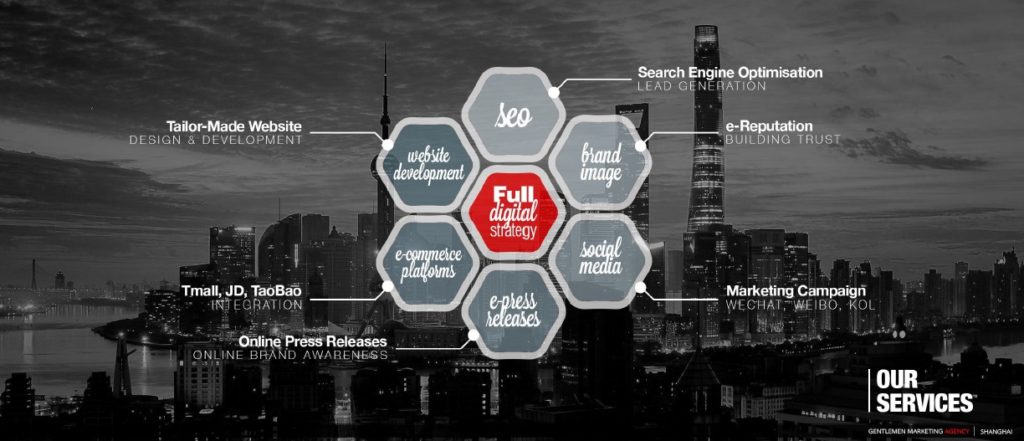
The old advertising model is dying in China. We are confronted with the digitalization of our society day after day. Today, everyone is connected and that’s not going to diminish right away. This is the direction in which you should orient your strategy. It is no longer a question of doing marketing the old-fashioned way, it has become obsolete. Especially when it comes to reaching other countries, which are, moreover, on another continent.
Your strategy must turn to digital in China
Your strategy must turn to digital. This will allow you to reach a wider audience that will be targeted. You will also have more control over your marketing actions.
Brand reputation : your foundation in China

Your brand image is an important issue in any country. Only in China, it will have even more impact. Indeed, the Chinese population has suffered from Internet scams for years. Consumers today are very distrustful when it comes to trust. Especially when there is money at stake. And all the more so when it comes to foreign companies.
Your brand image is the first thing you need to pay attention to. We will give you several tools to take care of this image. This way, you will be sure that the image you are sending back to us is well perceived. Above all, you will know that the message you want to convey is being transmitted and received correctly by your audience.
WeChat : the super App in China
You probably already know WeChat.
No?
It’s the most used application in China. (number of WeChat users)
Some people might compare it to Facebook. But that would diminish WeChat’s capabilities.
It’s not just about a few basic features. It represents a real opportunity for anyone who wants to do business there. You just need to know the features and how to use them.
First of all the application allows you to create groups by interest. This could allow you to transmit this famous message. But if the groups are by the interest it is also to allow you to target a specific audience. Your advertising message could thus have a wide reach and a targeted audience. This would already be a great leap forward for your advertising.
On the other hand, WeChat gives you the possibility to create a platform adapted to your activity.
What does this mean?
You can create mini-applications. Indeed, mini apps are very handy to divide your business into several parts and allow your customers to have a clear view.
These mini-apps can be customized as you wish. All you have to do is change the characteristics of the construction of your visual.
More information about WeChat and how to Make money on WeChat HERE
WeChat allow the 020 effect with QR code
online to offline or the contrary, WeChat develop the 020 and develop the connexion with the reality to the online world.
When you organize an event in China, you use WeChat to promote your event. And you will keep in contact with guests via WeChat.
Simple concept, but very effective.
“WeChat is the best promotional tool for an event companies in China, it is simple, everybody has it, People can pay. WeChat is better than a telephone number or email” explained the marketing manager of MVP event.

Tmall : the amazon of China
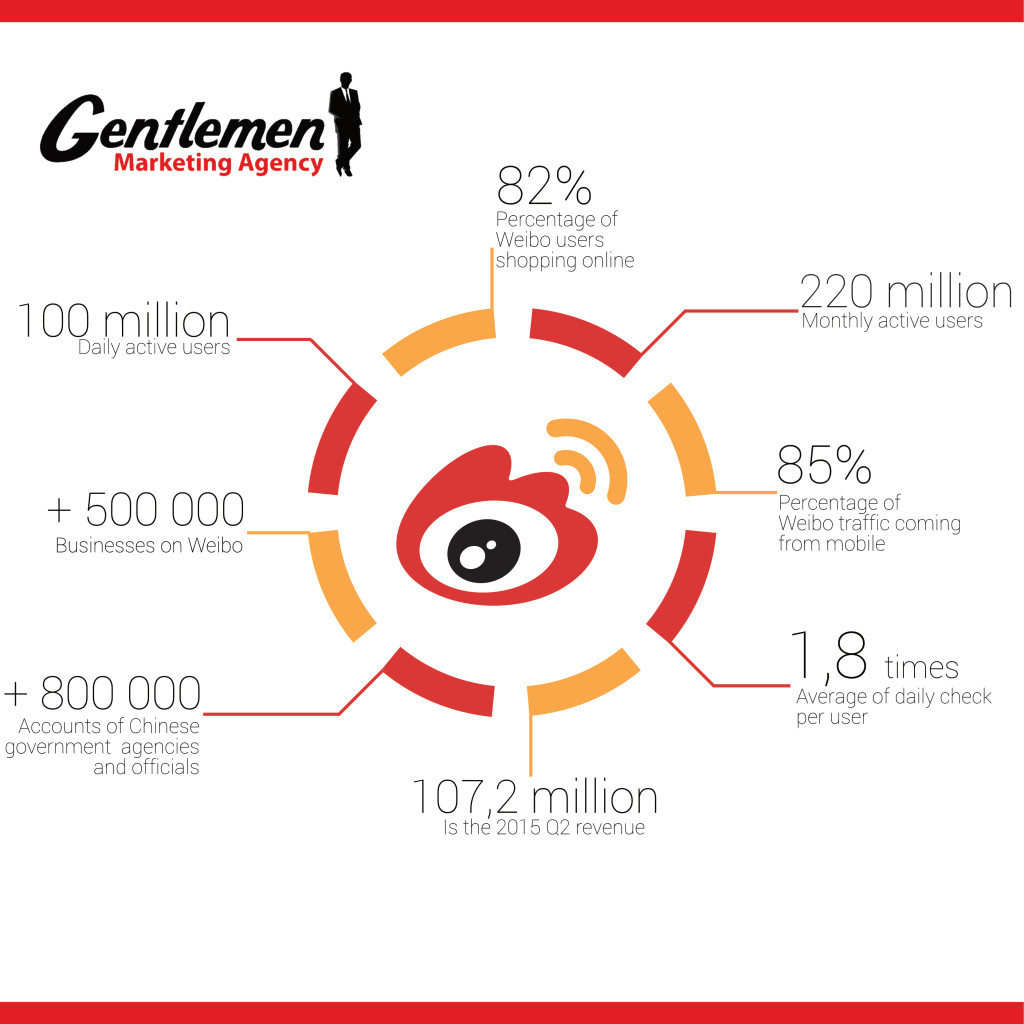
With its 100 million users per day, Tmall could be a key tool to sell your product on the Chinese market.
Indeed, Tmall is an online sales platform. Chinese consumers love this tool that allows them to access products they would never have had access to otherwise.
Don’t hesitate to learn more about the platform and get started. The results will be conclusive very quickly.
Read more about Tmall, the largest e-Commerce platform in China
KOL : Chinese influencers and bloggers

The KOL anagram refers to the expression “Key Opinion Leader“. These people are so called because they have real power to influence a large number of people.
Indeed, also called “influencers,” they are very connected and share their daily lives with thousands of followers.
Their publications are seen, commented on and shared constantly.
They will give you access to communicate with them if you manage to do business with them. They could advertise for you.
Many people in China think that KOL is a new media, and best media buying investment is to invest in them.
But how does it work?
Influencers are paid by companies either in money or directly in products. They take the product and display it in one of their publications. The product is then seen by its entire following community.
This is a huge advertising coup for the brands. Don’t hesitate to use it, especially for an audience that lacks confidence, such as the Chinese public.
More information about KOL in China
Do not hesitate to contact us for any added information







WeChat, Tmall, KOL, the establishment of a strategy in China can have a really wide scope and be very interesting.
Brand image and reputation is EVERYTHING in China. It is in other countries, but even more in this one. For that, digital content and reviews (also on digital platforms) are among the most important tools to build strong branding in China.
I also agree with what you said about Chinese platforms. Wechat and also tmall, two leaders companies can use together for an efficient marketing campaign…