
Solutions to Get a Chinese Business License

Are you in the business of doing anything that takes place or is based within Mainland China? If so, it’s probably time to take a look at your Chinese business license. This article will tell you everything there is about this important document and how it can help guide your company from being fined for not having one all the way up to registering an international trade name with the Ministry of Commerce!
You better watch your back in China! Filled with a long history of complicated and ever-changing bureaucracy, foreign entrepreneurs have found it challenging to obtain the much-needed business license. However, recent years have seen new regulations implemented by the Chinese government in an attempt to make China more friendly for foreigners as well as attract investors from all over the world; this is good news for those thinking about doing some profit-generating activity there.
Cost-Effective Agency
KPI and Results focused. We are the most visible Marketing Agency for China. Not because of huge spending but because of our SMART Strategies. Let us help you with: E-Commerce, Search Engine Optimization, Advertising, Weibo, WeChat, WeChat Store & PR.
Even though the new business reform hasn’t happened at the expected speed, 2018 has seen significant changes which confirms the government’s determination to continue this reform. Do you want to get a Chinese Business License? Do you need an agency that helps you with this process?
What is a Chinese business license?
The business license certificate is fairly consistent and often has the text “营业执照” (business license) in a large font. Many companies receive two versions of the certificate, one that’s A3 size for official purposes and another sized to be more convenient when carrying it around or photocopying it, which many businesses use as their primary version.
China operates a national company register. No matter the size or business, all companies in Mainland China need to apply for a license with the government’s Administration of Industry and Commerce (AIC). All things considered, it is highly advisable that any Westerner looking to do due diligence on their Chinese supplier gets this necessary first step out of the way before doing anything else.
What information should be on a Chinese business License
In China, business licenses are only issued in writing which makes them difficult to understand for foreigners. The license contains the essential details of company registration and specifies things such as:
- Includes the red national emblem with 5 stars
- Official Company Name
- Company Type
- Registered Address Legal Representative Registered Capital Date of Establishment
- License Expiry Date Business Scope
- 法定代表人 Legal representative
- Registration Bureau adresse

In mainland China, it is very common for many companies to display their business license. It’s a way of showing customers that they are legitimate businesses. When doing business with one of these Chinese establishments, you can request the company’s official document from them and make sure they’re on the up and up!
Features of a Chinese business license
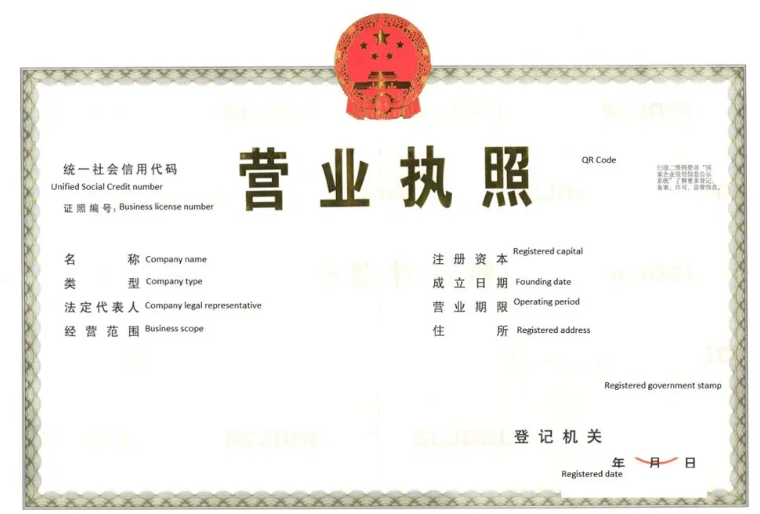
This is the standard business license needed to operate in China, the following information so will be displayed on it :
- Social credit and business license number
- Company name
- Company type
- Legal representative
- Business scope
- Registered capital
- Founding date & operating period
- Registration address
Why you should get a Chinese business license?
In China, having a business license is not always necessary to operate. However, if you want the opportunity for success in this market then it might be a good idea to have one of these licenses at your disposal. Having a Chinese Business License will definitely open up your scope of action in the country.
- Without a business license, you can’t get an ICP (Internet Content Provider) License (necessary for a website in .cn) but more importantly, you can not sell on the local version of any Chinese e-commerce platform, nor can you open a wechat official account.
- Many successful international brands have at least one branch based in China.
- The Chinese market is huge and it will serve as a good launching platform for any start-up looking to break into the market.
What is a Five-in-one Business license?
As the name Five-in-one suggests, this business license incorporates five different certificates :
- The Business License: is required for opening a bank account in China. This license includes key details about the company, including the name of the organization, registration number, and legal representative registered capital.
- The Business Tax Registration Certificate: This document contains the company’s tax number, and taxpayer name, and indicates the scope of the business.
- The Organization Code Certificate: The certificate of legitimacy is a crucial document for any company, as it not only provides an official seal to customers or clients that the business has met all necessary requirements set forth by the government but is also the one used in the countries digital data base.
- The Social Security Registration Certificate: It is mandatory for employers to register and contribute to the social security system. The document certifies that the company is compliant with this requirement.
- The Statistical Registration Certificate: This document is issued for statistical purposes, even though some regions like Shanghai and Guangzhou do not use it anymore.
The five-in-one business license includes key details about the company: name of the organization, registration number, legal representative, registered capital, and so on. An additional important feature is that this license is necessary to open a bank account in China.
How do you get a Chinese business license?
The registration process can be complicated for foreign companies. To get a Chinese business license, the company must register as an entity in China-whether it is WFOE or a Joint venture with local partners–and comply with all relevant laws and regulations.
- Wholly Foreign-Owned Enterprise (WFOE): If you’re looking to start a business in China, the best option for foreigners is with a wholly foreign-owned enterprise. A WFOE means that your company will be 100% owned by an overseas entity and can either run it or outsource management duties to another Chinese organization. This type of venture offers more freedom than joint ventures where the partner owns part of the company; all decisions are up to you as well as profits from revenues! With this preferential status, we recommend registering under WFOE if possible because there’s no better way into China at present time.
Steps to register a company in China (WFOE) and get a Chinese business license
- Register your company in China, documents and info required:
- The company name
- The list of controlling partners
- The managerial structure
- The legal address of your company in China
- Articles of Association
- Registered capital
- Total investment
- Apply for approval Certificate: RDV to the Ministry of Commerce (MOFCOM) and State Administration of Industry and Commerce (SAICt to have your application reviewed.
- Apply for Business License: Once issued with a business certificate, you will need additional license/s depending on the niche you are operating in. In China, businesses in manufacturing, food, beverages, construction, and telecoms require additional licenses. (How to Applying for a Chinese Business License, Certificates, or Permit from China Government
- Joint venture: A joint venture can be another type of company where it takes on limited liability form – just like your WFOE! But unlike with a WFOE, when conducting a Joint Venture there’s one big difference: The Chinese shareholder must make up at least 50% ownership percentage (rather than having a minority share). This means they’ll have a greater say not only in daily operations but also in any significant decision involving expanding or acquiring other businesses too. The main advantage of opting for a joint venture is that you can rapidly grow into the Chinese market by using the already established firms to tap into their information database, distribution networks, and sales channels. While these benefits are amazing, it’s important to note that with limited control over your investment in another person’s company- even if they’re trustworthy – there may be difficulty defending against corporate espionage or other unforeseen challenges. For many investors, this risk outweighs all possible rewards which is why we recommend choosing WFOE as your first choice instead.
- Representative office: An office is the simplest type of business you can open in China. It’s a great idea if you need to be present for only one or two purposes, like market research and customer support.
About Business in China: Read also
Need a Cost-Effective Agency to get you a Business License, we can help you.

- Contact us.
- Price starts at 5000$ depending on your situation and industry