
SEODu aka Baidu SEO in 2026: How to Submit Your Site to Baidu and Get Quoted
Updated

Forget the hype: Baidu is still the main search engine in China in 2026. Yes, WeChat, Douyin and Xiaohongshu are booming, but if you are serious about credibility, B2B leads and long-term digital authority, Baidu SEO is not optional. And it starts with a boring step most foreign brands get wrong: you have to submit your site to Baidu properly, then give its new AI answer something worth quoting.
I’ll break it down startup-style: what changed since the July 2025 overhaul, how to get indexed, where Baidu Zhidao and Baijiahao fit, and how to build a China-proof SEO plan that actually brings clients knocking. I call it SEODu, SEO done the Baidu way.
Jon Wang founded SEO Agency China and leads its Shanghai team, which does Baidu work for small foreign brands.
I set up Baidu Search Resource Platform accounts for foreign sites every month, so the submission mistakes below are ones I fix for real.
The harsh truth: Baidu still runs the show
Everybody loves to talk about Douyin trends or Xiaohongshu influencers, but here is the punchline: if you are not on Baidu, a big share of Chinese buyers who research before they buy will never find you.
Baidu is not just a search bar. It is a whole family of properties: Baidu Baike (like China’s Wikipedia), Baidu Zhidao (Q&A), Tieba (forums) and Baijiahao (publishing). Its results page pulls heavily from these, so the lesson has not changed: if you want credibility in China, you need to play inside Baidu’s house, not just around it.
What changed on Baidu between 2025 and 2026
An ICP licence, China hosting, mobile speed and Baidu’s own properties remain the base. What changed in the last 15 months is bigger than another ranking tweak. Baidu turned its results into an AI answer page, so the goal is no longer only to rank a blue link, it is to be the source the AI quotes.

1. The Smart Box and the Baikan answer page
At its AI Day on 2 July 2025, Baidu announced what Science and Technology Daily called the biggest search overhaul in ten years. The classic search bar became a Smart Box (智能框) that takes text of over a thousand characters and file uploads. The results page, Baikan (百看), now mixes text, images, audio and video into a structured answer, and Baidu said it would plug agents and human services into it.
For a brand, the core change is simple. People read the AI answer first. Your job is to be the clear, well-sourced page that answer is built from.
2. ERNIE 5.0 is the model reading your pages
Baidu launched ERNIE 5.0 at Baidu World on 13 November 2025 and put the official version live on 22 January 2026, a 2.4-trillion-parameter model that handles text, images, audio and video natively. The practical point: a model is often the first reader of your content, so write pages it can quote cleanly. Short answers, real numbers, named sources.
3. GEO now sits next to classic SEO
When the answer comes from AI, ten blue links matter less. The new game is GEO, getting your brand named and quoted inside AI answers. What works: keep one consistent entity (same name, facts and figures) across Baidu Baike, Baijiahao and your own site, and write answer-first. Put the direct answer in the first two lines, then the detail. If you want the policy side of this, read how China’s first GEO trust standard changes the rules for brands.
4. Baijiahao got busier, not quieter
At the 2026 Baidu Creator Conference in Zhuhai (23 to 26 April), Baidu said Baijiahao creator numbers grew 23% over the past year and daily new content rose 40%. More supply means more competition for the same slots. A foreign brand that posts one translated press release a month will drown. One that posts useful, specific answers every week still gets picked up.
| Area | Before July 2025 | 2026 |
|---|---|---|
| Results page | Ten blue links plus Baidu blocks | Baikan answer on top, mixed media, links below |
| Search input | Keywords in a bar | Smart Box: 1,000+ characters, file uploads |
| Model behind it | Earlier ERNIE versions | ERNIE 5.0, 2.4 trillion parameters |
| SEO goal | Rank a page | Rank a page and be the source the AI quotes |
| Baijiahao | Optional extra | Crowded: creators +23%, daily content +40% |
How to submit a site to Baidu in 2026, step by step

This is where most foreign sites lose months. You cannot just wait for Baidu Spider to find you. Here is the order I follow when we submit a site to Baidu for a client.
- Open a Baidu Search Resource Platform account (ziyuan.baidu.com, the tool people still call Baidu Webmaster Tools). The interface is Chinese only, and in practice you need a Chinese mobile number to register.
- Verify the site with a file in your root folder or a meta tag in the header. Since 2021 the link submission tool only serves verified sites, and a sitemap may only list URLs from its own site.
- Push new URLs through the API. Baidu’s own help pages call API submission the fastest method and recommend pushing each day’s new links the same day.
- Submit a flat sitemap for older pages. Baidu crawls sitemaps on its own schedule, so they are slower than the API. Do not submit a sitemap index (XML nesting XML): Baidu stopped processing them in July 2020, and the child files still eat your quota.
- Get your ICP filing number into the site settings. Since May 2021, sites without an ICP filing can submit only one sitemap file per day. Filed sites keep a higher quota.
- Check indexing with a
site:yourdomain.comsearch on Baidu after one to three weeks, and watch the crawl errors in the platform.
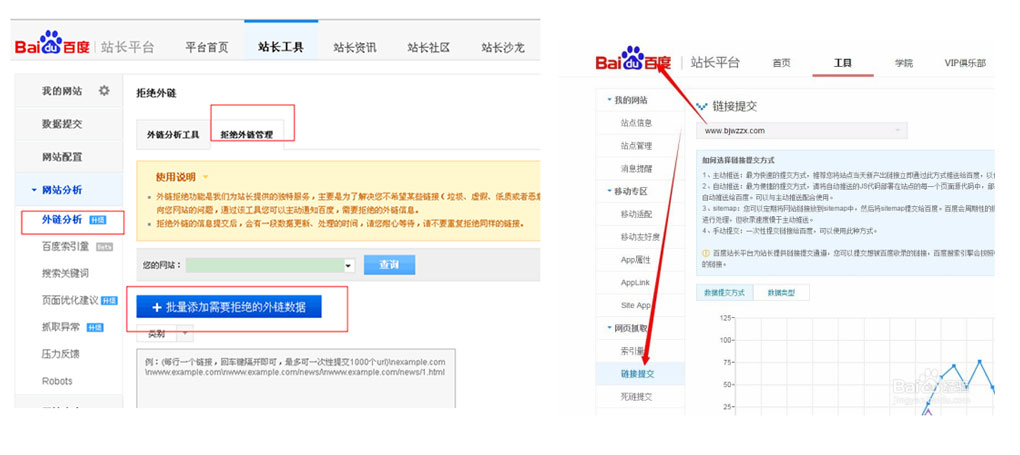
All of these rules are listed in Baidu’s own tool update log, which is worth reading once with a Chinese speaker. Submission does not guarantee indexing. It only shortens the time before the crawler visits. If the page is slow, thin or hosted far away, it can still sit outside the index.
What Baidu’s algorithm rewards in 2026
Baidu’s algorithm is smarter, tougher and way more China-first than it was a few years ago.
- Trust signals are king: if your site is not HTTPS, not hosted in or near China and has no ICP licence, you are losing the trust game before it even starts.
- Localized E-E-A-T: expertise, experience, authority and trustworthiness, but with Chinese flavor. Real Chinese case studies beat generic translated fluff every single time.
- Low-effort AI text gets spotted: if you think you can spam ChatGPT translations and win rankings, think again. Draft with AI if you like, polish with a local editor.
- Video and images take more space: the Baikan page mixes media into the answer, so a strategy with no video leaves you invisible to a big chunk of searchers.
- Question-style queries: with long prompts in the Smart Box, more people type full questions. Optimize for “怎么…” (“how to”) and “什么是…” (“what is”).
The big punchline? Quality + Localization > Quantity.
The technical foundations you can’t ignore
This is not sexy, but it is the difference between page one and nowhere.
- Get an ICP licence: without it you cannot host in mainland China, you load slower, and your submission quota stays low.
- Host in China or nearby: Tencent Cloud or Alibaba Cloud cut the latency. Faster load speed means more trust and better rankings. Our guide to building a website that works in China, with hosting and ICP covers the setup.
- Mobile-first or bust: most Chinese searches happen on a phone. If your site is not built for mobile, Baidu will bury you.
- Keep content in the HTML: Baidu Spider still struggles with pages that load their text through JavaScript. Put the title, the first paragraph and the key answer in plain HTML.
- HTTPS everywhere: if your site is not HTTPS, you are losing the trust game before it starts.
Think of it like this: technical SEO in China is not about being fancy. It is about proving to Baidu you’re serious.
Content that actually works on Baidu
Our take at SEO Agency China: content is not the king on Baidu, it is the base of the pyramid. Everything else sits on top of it.

- Write in Simplified Chinese, no lazy translations. Use local idioms and references your buyers recognise.
- Put the keyword in the first paragraph and in the title. Baidu still rewards old-school placement, and the AI answer reads your opening lines first.
- Pick your keywords from Chinese data, not from your English list. Our walkthrough of keyword research on Baidu shows how.
- Show Chinese proof: if you are a foreign education company, do not talk about “scholarships abroad” in general. Show the path of one Chinese student, with the school, the dates and the result.
- Mix formats: articles on Baijiahao, Q&A on Zhidao, short videos for Bilibili, visual posts for Xiaohongshu.
Pro tip: Chinese users care less about polished English-style branding and more about proof that you get their world.
Baidu Zhidao, Baike and Baijiahao: use Baidu’s own properties
Here is where many foreign brands crash and burn: they try to outrank Baidu on Baidu. That is like opening a coffee shop inside Starbucks. The smarter play is to show up on the properties Baidu already trusts.

- Baidu Zhidao (百度知道): Baidu’s Q&A site. Find the real questions buyers ask in your category (“哪个牌子的…好”, “…怎么选”) and answer them in plain Chinese with specifics. In my experience, answers that read like ads or carry a naked link get folded or removed, while detailed, neutral answers keep showing in Baidu results for years.
- Baidu Baike (百度百科): your encyclopedia entry in China. It needs citations from Chinese media, and it is one of the places the AI answer checks your facts against.
- Baijiahao (百家号): publish thought-leadership weekly. It is indexed far faster than a new foreign domain.
- Tieba: join the conversation where your niche already talks. Do not spam it.
Zhihu is not a Baidu property, but its answers often rank on Baidu too, and the way Zhihu ranks answers rewards the same habits. And yes, create videos for Bilibili. Baidu pushes its own content higher, period. Don’t fight it. Use it.
A worked example: an ed-tech startup on Baidu
Picture Emma, marketing lead at a UK ed-tech startup that wants to recruit Chinese students. She is invented for this guide. Her Chinese site has 120 pages, yet after six months a site: search on Baidu shows only 9 indexed and zero enquiries from search.
What failed: the site was hosted in London, the Chinese text was machine-translated from English, and the team had submitted a sitemap index file to Baidu. Baidu ignores index files, so most URLs were never queued.
What worked, in order: an ICP filing through a Chinese partner and a move to Alibaba Cloud; a flat sitemap plus daily API pushes; 30 pages rewritten by a native editor around real questions such as “英国读研奖学金怎么申请”; weekly Baijiahao posts; and ten detailed Zhidao answers written by a Chinese alumna. Why it worked: Baidu could finally crawl the site fast, and the AI answer had specific, consistent Chinese pages to quote.
A credible result after another six months: most pages indexed, the Baijiahao posts showing for long-tail scholarship questions, and a steady trickle of parent enquiries instead of none. Not a miracle. A fixed pipeline.
Mistakes that kill foreign SEO in China
- Keyword stuffing: Baidu is stricter than Google about spammy titles. Keep it natural.
- Ignoring mobile UX: instant SEO death.
- Waiting instead of submitting: no API push, no verified account, a sitemap index nobody reads.
- Skipping Baidu properties: you can’t win against Baidu in its own playground, so join it instead.
- Copy-paste translations: Chinese readers smell it a mile away, and so does the AI that writes the answer box.
In short: if you cut corners, Baidu will cut you off.
Your Baidu SEO action list for the next 90 days
- Week 1 to 2: start the ICP filing, open the Search Resource Platform account, verify the site.
- Week 3 to 4: flat sitemap, API push wired into your CMS, HTTPS and mobile speed checked from a Chinese connection.
- Month 2: rewrite your ten most important pages answer-first in Simplified Chinese, open a Baijiahao account, post weekly.
- Month 3: answer real buyer questions on Zhidao, prepare the Baike entry, then measure what got indexed and what the AI answer quotes.
Forget Western SEO hacks and one-size-fits-all content. If you want credibility, leads and real brand authority in the world’s biggest digital market, you need a China-first, Baidu-native strategy. Because in the end: if Baidu doesn’t trust you, neither will your clients.
FAQ
How do I submit my site to Baidu?
Register on Baidu Search Resource Platform (ziyuan.baidu.com), verify the site with a file or meta tag, then push new URLs through the API and submit a flat XML sitemap for older pages. The platform is in Chinese and registration in practice needs a Chinese mobile number. Submission speeds up crawling but does not guarantee indexing, so fix speed and content first.
How long does it take Baidu to index a new site?
For a verified, fast, China-hosted site with API pushes, we usually see the first pages indexed within one to three weeks. A foreign-hosted site with no ICP filing and machine-translated pages can wait months and still see only a handful of URLs indexed. Baijiahao posts are often indexed much faster than a new domain, which is why we start publishing there early.
Is Baidu Zhidao still useful for SEO?
Yes, if you use it as a Q&A site and not as a link farm. Zhidao threads still show in Baidu results for “which brand” and “how to choose” questions. Write detailed, neutral answers in native Chinese, mention your brand only where it helps the reader, and avoid naked links. Promotional answers tend to get folded or removed.
Does Baidu use AI in search results now?
Yes. Since the July 2025 overhaul, the search bar is a Smart Box that accepts long text and files, and the Baikan results page builds a structured AI answer from text, images and video before the classic links. The links are still there, but the answer comes first, so the aim is to be a source that answer quotes.
What is GEO and how is it different from Baidu SEO?
Classic SEO tries to rank a page in the list of links. GEO (generative engine optimization) tries to get your brand named and quoted inside the AI answer. It works best when you keep one consistent entity across Baidu Baike, Baijiahao and your own site, and write answer-first, with the direct answer in the first two lines.
Do ICP licence and China hosting still matter in 2026?
Yes. The AI layer sits on top of the basics, it does not replace them. An ICP filing, hosting in or near China, fast mobile pages and a verified Search Resource Platform account still decide whether Baidu crawls and trusts your site. Sites without an ICP filing also get a smaller sitemap quota. Without the basics, the AI has nothing solid to quote.
Getting your site indexed and quoted by Baidu
We set up the Search Resource Platform, fix the submission pipeline and write answer-first Chinese pages that Baidu’s AI can quote.
Our Baidu SEO service in Shanghai handles the ICP, hosting and indexing work, and our GEO service covers the AI answers.
Send us your domain through the contact page and we will tell you what Baidu sees today.