
Chinese Real Estate Investors: Where They Buy Abroad, Money Rules and 19 Articles to Reach Them

Chinese real estate investors still buy abroad in 2026, but the map and the money have changed. The United States took the most Chinese money in the year to March 2025, with US$13.7 billion of homes according to NAR. Thailand remains the top market by condo units, and Japan, the UAE, Malaysia and Singapore pull steady demand. Australia, long the first choice, has banned most foreign purchases of existing homes since April 2025.
The rules matter as much as the places. Each mainland Chinese adult has a foreign exchange facilitation quota equal to US$50,000 a year. It is not a hard cap: larger amounts pass with proof of a real current-account use, such as tuition. But the purchase declaration forbids using personal foreign exchange to buy property abroad, or for securities and life insurance, as the SAFE service guide states. Companies face their own limit: since August 2017, outbound investment in real estate sits in the restricted category of the State Council guidance on overseas investment.
So who actually completes a purchase? Mostly people who already hold money outside the mainland: families with a Hong Kong or overseas account, owners of businesses abroad, emigrants, and parents of students already enrolled overseas. They read for months, in Chinese, on Xiaohongshu, Douyin, WeChat and Baidu, before they speak to an agent. A project that is missing from that research does not exist for them.
This guide links 19 articles from our blog, sorted by the questions property developers, agents and investment firms ask us. Every entry has a short summary and a line from the text, so you can jump straight to the right read.
Jon Wang founded SEO Agency China, a small Shanghai team that helps foreign SMEs get found and trusted on Chinese search and social apps. He works with overseas developers and agents who want Chinese buyers to find their projects on Baidu, Xiaohongshu and WeChat, and to understand the money rules before a deal starts.
What this guide covers
- Where do Chinese investors buy property abroad?
- Which destinations attract Chinese buyers right now?
- Why do wealthy Chinese look abroad, and what limits them?
- How do Chinese buyers research property online?
- Should you work with real estate agents in China?
- How do you reach the wealthiest buyers?
- FAQ
Key numbers on Chinese property buyers
| Fact | Source |
|---|---|
| Annual foreign exchange facilitation quota per mainland individual: the equivalent of US$50,000, counted per calendar year, unused amounts cleared on 31 December | SAFE Xiamen Branch, individual FX service guide |
| Individual FX purchases may not be used to buy property abroad, nor for securities or life insurance; lending or borrowing another person's quota is also forbidden | SAFE Xiamen Branch, individual FX service guide |
| Chinese buyers bought US$13.7 billion of existing US homes (11,700 homes, 15% of foreign buyers, rank 1) between April 2024 and March 2025 | National Association of Realtors, July 2025 |
| Chinese nationals took 4,940 Thai condo units in 2025, down 12.9%, still 33% of all foreign condo transfers | REIC data via Khaosod English, March 2026 |
| Australia temporarily bans foreign persons, including temporary residents, from buying established dwellings from 1 April 2025, unless an exception applies | Foreign Investment Review Board, Australia |
| China was forecast to lose a net 7,800 millionaires in 2025, second after the UK (16,500); the UAE was the top destination with a net inflow of 9,800 | Henley & Partners, Private Wealth Migration Report 2025 |
Each section answers one question we hear from developers, agents and investment firms. Under each link you get two images, a short summary written for this guide and a line quoted from the article. Read the key numbers first, then jump to the section that matches your project. The FAQ at the end answers the money and visa questions in plain words.
Where do Chinese investors buy property abroad?
Chinese overseas buying peaked around 2016, fell hard after the capital controls of 2017, and has come back in a different shape since 2024. Fewer corporate megadeals, more private families buying for their own use. These four articles give the map and the buyer profiles behind it. Read them in order: the first two describe today, the last two explain how the market got here and where small developers fit.
Where Chinese buy overseas properties?

Start here if you need the short list. The piece maps where Chinese buyers spend in 2025 and 2026, from Thailand and Malaysia to the US, Canada and Dubai, and explains the shift from emigration to family use. Useful for developers deciding which markets to pitch first.
If your project is not shown there with real photos and real answers, you are invisible to this group.
Read the full article: Where Chinese buy overseas properties?
How to sell properties to Chinese real estate investors?

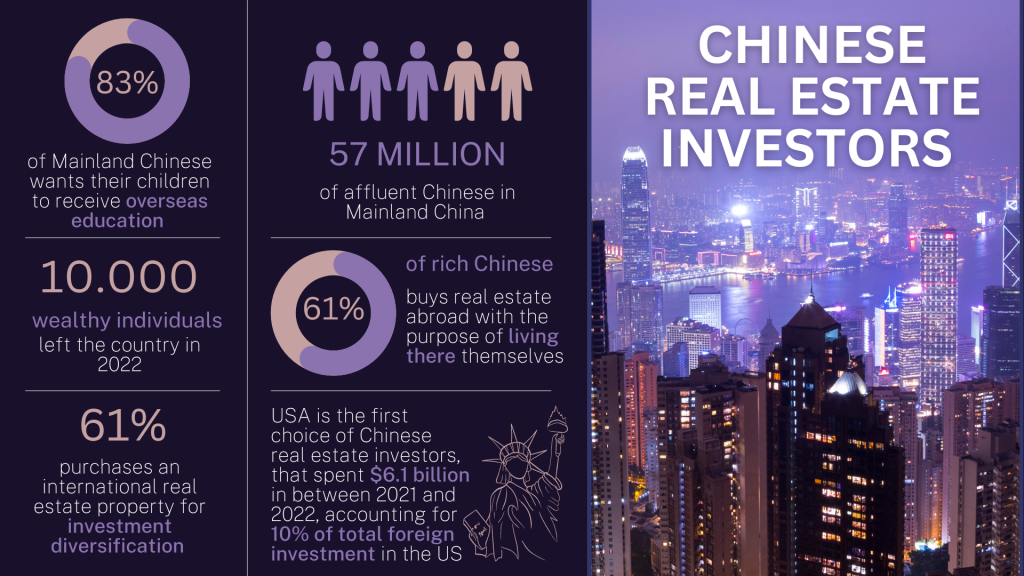
A long read for sales teams. It ranks eight destination markets, sketches four buyer personas, from the legacy builder to the education parent and the value hunter, and lists what Chinese investors expect after the sale, including property management in Chinese. Best for agencies building a pitch deck or a Chinese brochure.
As remote ownership becomes the norm, there is soaring demand for professional, multilingual teams that offer smooth communication and property management
Read the full article: How to sell properties to Chinese real estate investors?
International Real Estate Market for China

History that still explains today. The text goes back to the 2016 to 2018 period, when Beijing curbed corporate buying abroad and big groups such as Wanda and HNA had to sell assets. Read it to understand why institutional Chinese money left London and New York and why private buyers now lead.
Under the influence of tightening financial policies, China's overseas real estate investment will remain low and stable, and Chinese investors are becoming more and more rational.
Read the full article: International Real Estate Market for China
Chinese investors : Guide for Startup in Real estate


A quick trend sheet for startups and small developers. It covers the move toward Southeast Asia and Southern Europe, education-led purchases, commercial assets and remote buying tools, then shows how Douyin and WeChat bring in leads. Good as a briefing before a first China campaign. Pair it with the destination articles below for the details.
Chinese investors are increasingly purchasing property in countries that are considered to have high educational standards and a better quality of life.
Read the full article: Chinese investors : Guide for Startup in Real estate
Which destinations attract Chinese buyers right now?
Each market pulls a different buyer. The UAE draws business owners with no annual property tax and long residence visas. Thailand draws yield and lifestyle buyers on condos, where foreigners may own up to 49% of a building. Australia led for years, until its 2025 ban on foreign purchases of existing homes. Before you pick a market to target, check two things: the local rules for foreign buyers, and whether Chinese buyers already talk about that city on Xiaohongshu. If nobody does, you will be paying to create the demand yourself.
Dubai Is A Hot Spot For Chinese Real Estate Investors

Dubai explained for marketers. The piece lists why Chinese investors pick the emirate: no annual property tax, direct flights, safety, residence visas and Belt and Road ties. It also profiles the typical buyer and the luxury and commercial assets they target. Useful for UAE developers drafting Chinese sales material.
Investing in Dubai's real estate market is considered tax-free, as there is no annual property tax or income tax .
Read the full article: Dubai Is A Hot Spot For Chinese Real Estate Investors
Abu Dhabi’s Luxury Property Boom: Why Chinese Buyers Are Flocking In


Abu Dhabi as the cheaper, quieter alternative to Dubai. Expect price and yield data by district, the islands Chinese buyers ask about, and a frank list of hurdles: the pull of Dubai, freehold rules, anti-money laundering checks. Written for UAE brokers and developers who want a China plan.
Chinese buyers value prestige and community. They prefer properties in areas with Chinese shops, schools, or expat networks.
Read the full article: Abu Dhabi’s Luxury Property Boom: Why Chinese Buyers Are Flocking In
Thai Real Estate Boom in the Era of Chinese Investment


Thailand seen from both sides. Chinese buyers took almost half of foreign condo transfers in early 2023 and pushed up prices in Bangkok and Chonburi, which raised local affordability questions. The second half shows how a developer gets seen on Xiaohongshu and WeChat, where these buyers compare projects.
But Chinese buyers research overseas property entirely in Chinese, on Xiaohongshu and WeChat, before they ever contact an agent.
Read the full article: Thai Real Estate Boom in the Era of Chinese Investment
Chinese Real Estate Investors Are Back In Australia


Written when Chinese enquiries for Australian homes jumped in 2023, it explains the pull of Sydney's Upper North Shore, Melbourne and the Gold Coast: schools, lifestyle, exchange rates. Read it with one update in mind: since April 2025 most foreign buyers cannot purchase existing Australian homes.
These affluent areas offer not only prime real estate but also access to top-quality schools, lifestyle amenities, and easy commute options to the city center
Read the full article: Chinese Real Estate Investors Are Back In Australia
Why do wealthy Chinese look abroad, and what limits them?
Two forces meet here. At home, falling prices and developer defaults ended the idea that an apartment is the safest place for savings. At the border, the foreign exchange rules make it hard to move that money. Read these four together before you build a China sales plan. The last article in this section is the one we send most often to new clients, because it explains why a keen buyer can still disappear at the payment stage.
China's property market in decline as wealthy Chinese look abroad for a solution


The push factor, in numbers. Using National Bureau of Statistics data, it tracks how falling prices, developer defaults and a shrinking population broke the old belief that a Chinese apartment is the safest savings. Read it to explain to your board why Chinese capital keeps looking for a home abroad.
For two decades, Chinese residential property was the default savings vehicle for the middle class and wealthy alike.
Read the full article: China's property market in decline as wealthy Chinese look abroad for a solution
The Dilemma of 300 Millions China's Unsold Houses


China's housing glut, explained without drama. The update separates completed unsold stock from undelivered pre-sales, cites official and bank estimates, and shows why lower prices have not brought confidence back. Good background for anyone who must explain why domestic property lost its role as a store of value.
When real estate no longer stores value reliably, the investment motive disappears.
Read the full article: The Dilemma of 300 Millions China's Unsold Houses
China’s Super rich are seeking Seconds passports


Why rich Chinese families want a second passport or residency: travel freedom, schooling, healthcare, safety and spreading their assets. The article runs through the routes Chinese applicants use, from Malta and Portugal to the UAE and Caribbean programmes. Relevant for developers who sell property linked to residency.
Visa-free travel is a key motivation, given the limitations of the Chinese passport
Read the full article: China’s Super rich are seeking Seconds passports
The 50,000 Dollar Ceiling on What Chinese Buyers Can Spend Abroad

The page every foreign seller should read before setting prices. It explains the US$50,000 facilitation quota, the purpose declaration banks now require, and the ban on using personal foreign exchange for overseas homes. It then shows how to adapt offers, payment pages and targeting to those rules.
Buying overseas real estate with individual foreign exchange is prohibited, and those who breach it can be placed on a watch list.
Read the full article: The 50,000 Dollar Ceiling on What Chinese Buyers Can Spend Abroad
How do Chinese buyers research property online?
A Chinese buyer may read about your project for months before sending a single message. That research happens in Chinese, on Xiaohongshu, Douyin, Baidu and WeChat. These three pieces show what to publish on each app and how to turn views into qualified enquiries. One rule runs through all of them: answer the awkward questions, about payment, fees, taxes and after-sales service, in plain Chinese before the buyer has to ask.
Douyin : the Livestream Revolution for Real Estate In China


How Chinese agents moved property sales onto Douyin livestreams, starting with agent Wang Shujuan's virtual tours in 2020. The piece links that habit to overseas buying and shows how video, live questions and WeChat follow-up build trust for a high-value purchase. Worth reading before you film a project tour.
Video builds the trust that static listings cannot, which matters for high-value purchases.
Read the full article: Douyin : the Livestream Revolution for Real Estate In China
Real Estate: how to generate thousands of leads from China?


A practical lead checklist for property firms: Baidu SEO and paid search, reviews and reputation, Chinese content and video. It includes a sample annual budget and a list of Douyin formats agents use. Treat the budget figures as an order of magnitude, not a promise. The sections on reputation and video still hold up.
If the quality of your video is good, it will be easier for potential buyers to trust your business and product, and then they might contact you.
Read the full article: Real Estate: how to generate thousands of leads from China?
How Foreign Property and Lifestyle Brands Reach Chinese Buyers


For developers, resorts and lifestyle brands selling big-ticket offers to Chinese buyers. The core idea: these buyers research for weeks, so you need desire on Xiaohongshu and Douyin, reassurance on Baidu and a steady relationship on WeChat. Short, clear and free of hype. A good first read for a marketing manager new to China.
A high-value offer that is invisible or unconvincing there loses to a lesser one that shows up well.
Read the full article: How Foreign Property and Lifestyle Brands Reach Chinese Buyers
Should you work with real estate agents in China?
Most overseas property sold to Chinese buyers passes through an agent at some point. You can partner with agencies in China or hire your own team. Both routes need the same thing from you: a brand that looks credible when agents and their clients check it. Check any partner the way a Chinese client would: search the agency name on Baidu, read what people say on Xiaohongshu, and ask for references from past overseas sales.
How to collaborate with Chinese Real estate agents in 2024?

How to work with agents in China rather than around them. It opens with 2026 market data, then lists ten ways to partner, from WeChat and Douyin co-marketing to referral programmes and a Baidu-indexed Mandarin site. For overseas developers looking for a Chinese sales channel.
Chinese agents increasingly demand Mandarin-language digital assets, including a locally hosted website and Baidu-indexed content, before agreeing to referral partnerships with overseas developers.
Read the full article: How to collaborate with Chinese Real estate agents in 2024?
How To Recruit Real Estate Agents In China ?


If you need your own sales force in China, start here. It covers the job portals (Zhaopin, 51job, Liepin), the weight of guanxi and mianzi, pay and incentives, and why good agents only join brands that look credible on Baidu and WeChat. Read it alongside the partner guide above before you choose one route.
Good agents join brands that look credible online, and clients pick agencies they can find and trust on Baidu and WeChat.
Read the full article: How To Recruit Real Estate Agents In China ?
How do you reach the wealthiest buyers?
The families who can buy abroad without breaking the rules usually already hold assets offshore. They are few, discreet and well advised. Reaching them is about reputation and introductions, not mass advertising. For a foreign brand, that means a Baidu result page with nothing alarming on it, a Chinese profile that matches your English one, and partners who can vouch for you.
How to Reach China's Truly Affluent Buyers

Not every rich buyer is reached the same way. This short piece separates everyday luxury shoppers from high net worth families, who buy property at home and abroad through referrals, advisers and private WeChat groups. Useful for premium developers who depend on introductions. It also explains why loud campaigns put this group off.
The genuinely affluent in China move through private networks, referrals, trusted advisors, and tight WeChat circles.
Read the full article: How to Reach China's Truly Affluent Buyers
How Wealth Management Firms Can Reach Chinese Investors


For wealth managers and investment firms that sell to the same families who buy property abroad. The focus is reputation: what a cautious investor finds on Baidu, clear Chinese content, consistent signals. It stays on the marketing side and leaves products and compliance to licensed professionals. The verification logic applies just as well to developers.
What they find on Baidu shapes whether they proceed or quietly move on
Read the full article: How Wealth Management Firms Can Reach Chinese Investors
Frequently asked questions
Are Chinese investors still buying property abroad?
Yes, but fewer of them, and more carefully than in 2016. NAR counted US$13.7 billion of US home purchases by Chinese buyers between April 2024 and March 2025, the most of any foreign nationality. In Thailand, Chinese buyers still took a third of foreign condo transfers in 2025, even though their units fell 12.9%. Most now buy for family use, schooling or a second base, not for a quick resale. For a destination by destination view, see where Chinese buy overseas properties.
Where do Chinese people buy the most property overseas?
By value, the United States leads, with California the usual first choice. By number of units, Southeast Asia weighs more: Thailand first, with Bangkok, Chonburi and Chiang Mai taking most Chinese condo transfers, then Malaysia. Japan, Singapore, Hong Kong and the UAE complete the shortlist, and Dubai is now a standard option for business owners. Canada and the UK still attract families with children at school there. Australia dropped down the list after its 2025 ban on foreign purchases of existing homes.
Can Chinese citizens legally buy property abroad?
Chinese law does not stop a citizen from owning a home abroad. The limit sits on the money. Foreign currency an individual buys in China may not be used for overseas property, because property is a capital account item not yet open to individuals. Buyers who complete a purchase legally usually pay with funds already held offshore, foreign income, or money moved through an approved channel. The destination’s own rules apply on top, such as Canada’s foreign buyer ban or Thailand’s 49% foreign quota per condo building.
How much money can a Chinese person take out of China each year?
Each mainland individual has an annual facilitation quota equal to US$50,000 to buy foreign currency at a bank. It runs per calendar year and unused amounts do not roll over. It is not an absolute ceiling: larger sums for real current-account needs, such as tuition or medical bills, pass with documents. Every purchase needs a declaration of purpose, and lending your quota to a relative, or borrowing theirs to split a large payment, is forbidden. See the 50,000 dollar ceiling.
So how do Chinese buyers pay for property abroad?
Mostly with money that is already outside the mainland. Typical sources are a Hong Kong or overseas account built up over years, income from a business abroad, the proceeds of an earlier overseas sale, or a local mortgage where the destination allows it. Families with children studying abroad often buy near the school once funds are in place. For a seller the lesson is simple: your real prospect is often someone with offshore assets, and their adviser, not a first-time buyer sitting in Shanghai.
Why do wealthy Chinese invest in real estate abroad?
Four reasons come up in almost every client conversation: spreading risk away from a falling domestic property market, children’s education, a safe store of value under a stable legal system, and a residence option. Henley & Partners forecast a net outflow of 7,800 Chinese millionaires in 2025, second only to the UK. With home prices in China down for years, overseas property now looks like protection rather than speculation. This analysis of the domestic slump sets out the numbers.
Can Chinese buyers still buy homes in Australia?
Mostly not existing homes. Since 1 April 2025, foreign persons, including temporary residents and foreign-owned companies, are banned from buying established dwellings in Australia unless an exception applies. New builds and off-the-plan projects remain open with Foreign Investment Review Board approval, and permanent residents are not covered. Australian developers still market to Chinese buyers, but the message has moved to new projects and to families who already hold residency. Our Australia article gives the picture before the ban.
Does buying property give Chinese investors a residence visa?
In some countries, yes, and that link drives a lot of demand. The UAE grants a long-term Golden Visa to property buyers above a set value, one reason Dubai and Abu Dhabi rank high with Chinese business owners. Greece still offers residence through property, at higher thresholds than before. Portugal closed its real estate route in 2023, and Australia and Ireland ended their investor visa schemes. Rules change often, so check official sources before you put a visa promise in Chinese marketing.
Where do Chinese buyers search for overseas property online?
Almost entirely in Chinese apps. Xiaohongshu is the research notebook, where owners post neighbourhood reviews, school notes and price comparisons. Douyin carries video tours and livestreams. WeChat is where enquiries, documents and long conversations happen, through official accounts and private groups. Baidu is the checking tool: before calling an agent, buyers search the developer’s name to see if it is real and has a clean record. Listing portals help, but trust is built on those four apps.
How do I find Chinese real estate investors for my project?
Pick one or two buyer types first: education parents, business owners who want a second base, or yield investors. Then build a Chinese presence they can check: a Mandarin landing page indexed on Baidu, a Xiaohongshu account with real photos and honest answers, short Douyin tours, and a WeChat account to handle enquiries. Partner with Chinese agents who already hold client lists, and publish the payment path openly. Our lead generation guide for property breaks the steps down.
Should overseas developers work with agents in China?
Usually yes, because agents hold the relationships and Chinese buyers rarely commit to a stranger. Expect agents to ask for Mandarin sales kits, a Chinese website, proof of past sales and a clear commission structure before they push a project. Check their licence and reputation the way a buyer would, on Baidu and WeChat. Keep your own channels running too, so your leads do not depend on one partner. Ten ways to collaborate with Chinese agents lists the options.
Is Thailand or Dubai more popular with Chinese buyers?
They serve different buyers. Thailand wins on volume: Chinese nationals took 4,940 condo units there in 2025, more than any other foreign group, mostly in Bangkok, Chonburi and Chiang Mai, at prices a middle-class family can reach. Dubai wins on ticket size and on residence: business owners buy villas and branded apartments there, with no annual property tax and a Golden Visa option. If your project is under US$300,000, Thailand-style marketing on Xiaohongshu fits. Above that, think the Dubai buyer profile.
Reaching Chinese property buyers with us
Chinese property buyers decide after months of reading in Chinese, and most foreign projects are missing from that research. Our small Shanghai team builds the Baidu pages, Xiaohongshu and WeChat accounts and lead tracking that put a developer or agency in front of qualified buyers, and we flag the money rules before a deal stalls at the bank. See our lead generation service for China, or tell us about your project.
Last updated: October 2026. This guide is reviewed when new articles are published on the topic.